Analyitics
Thursday, April 23, 2015
Friday, April 17, 2015
Brock Holt - Too Valuable to Start
Baseball is a funny game. On one hand, it seems very simple. Throw ball, hit ball, catch ball. But part of the allure of the game is how complex the game actually is under that surface.
This came to mind yet again as I read Over the Monster's article What needs to happen for Brock Holt to play full-time for the Red Sox? The main point of the article is that the same thing that makes Holt valuable to the Sox – his above average versatility – will prevent him from being a starter. As Matt Collins writes:
Cross Posted on Thought Ambience
This came to mind yet again as I read Over the Monster's article What needs to happen for Brock Holt to play full-time for the Red Sox? The main point of the article is that the same thing that makes Holt valuable to the Sox – his above average versatility – will prevent him from being a starter. As Matt Collins writes:
Last season was his coming out party to the league, and he played almost literally everywhere. He logged 327 innings at third, 264-2/3 in right, 101 at short, 74 at second, 57-2/3 in center, 70-1/3 at first and 60 in left. He joined Denny Hocking as the only players since 1914 to play at least eight games at each position besides pitcher and catcher. One would think that would be enough to earn an everyday role somewhere, but on this team, Holt might be too valuable on the bench to have a consistent spot in the lineup.This seems counter intuitive until you dive into the logic. As Collins details, in every position on the field, the Sox have better options then Holt at each single position, both as a starter and as a backup, but nobody that's a better option for ALL of the positions. (Catcher and Pitcher excluded, of course, but honestly i'd like to see Holt give those a go as well.) Holt's value as a backup extraordinaire outweighs his value at any single position. Bizarre. But at the end of the day, we're lucky to have a player like him - I have no doubt he'll prove his worth many times over the course of the season.
Cross Posted on Thought Ambience
Monday, April 13, 2015
Wednesday, January 21, 2015
Saturday, January 17, 2015
Review of David Mitchell's "The Bone Clocks"
David Mitchell is a smart man. He’s written six novels, and like any good postmodernist, all of them have both small and large connections with each other. (More astute readers than I have found them all – check out this Good Reads review for a summary.) Decrypting these puzzling connections both within and between his books, and pondering what they mean, is a lot of the fun of reading Mitchell. And unlike, say, the puzzles of Christopher Nolan’s films, where amazing characterization –being caught in another’s thoughts and voice IS the meaning – Mitchell strives for more. His last book, The Bone Clocks, just leaves me wondering just what exactly that more is.The hyper connectedness of his novels hints at some kind of vague spirituality, of a (benevolent?) energy making order out of the universe’s chaos. It’s what seemed to be behind the various reincarnations of the characters in Cloud Atlas, for example. But in TBC the connections are revealed to not be the result of a mysteriously divine process, or even the whims of an obscure deity; rather it’s a shadow society of supernatural beings. And, naturally, there’s a good group and an evil group of these characters. Make no doubt about it, by the 3rd quarter of the book, Mitchell has fully embraced fantasy. At first I thought Mitchell might be writing a parody, but no: the TBC is in earnest, writing about astral battles with the same conviction and energy as the “real world.” He even comes up with his own obscure and confusing terminology (Horologists! Anchorites! Psychosoterica!). And while an author like Thomas Pynchon might play with the genre to make it serve his own purposes, creating an ironic detachment while commenting on the meaning of it all, Mitchell makes it the driving force of his story.
I found this approach to be reductive and unsatisfying, taking away the power of what came before. By reducing the hints of a larger pattern to the universe in favor of good vs. evil, it abdicates the field he set up by reframing it midway through the game. And I write this as a fan of fantasy novels, one who believes that, say , Neil Gaiman or Ursula LeGuin have a lot of meaningful things to say about our world. So fantasy is not in and of itself a bad thing. So why does Mitchell’s fantasy not work for me while others do? I suspect it’s because authors like Gaiman and LeGuin present those elements of their stories from the beginning, and so you’re on constant footing throughout. But when Mitchell, who has written so insightfully and beautifully about the nature of reality and our perceptions of it, introduces fantastic elements into an interconnected world previously without it, – well, I felt let down. Like he belittled what came before it. (Which is a funny thing to say about a book like Cloud Atlas that did include SciFi and Fantasy elements, but I felt the two books dealt with it differently.)
Now, all of this isn't to say that TBC is not an excellent book. On the contrary, the novel contains the same furiously addictive prose, the excellent characterization, diving into motivation, seamless weaving of historical events and trends into the plot as the best of his work. I was thoroughly entertained. But by the end of the book, the edge was taken away. In the final section, I never was too concerned with Holly and her children, despite the mounting tension and danger – you just KNEW Marinus would appear and save the day. And my ambivalence of TBC stems from my mourning of that mystery. I’m curious to see if he continues the fantasy in his next book, supposedly “set in the same universe” as The Bone Clocks. Because regardless of what I've written above, he’s still one of the best authors writing today. I can’t wait for more.
Cross Posted on Thought Ambience
Wednesday, January 14, 2015
Wednesday, December 31, 2014
Japan Trail Running Pictures
On the last day of 2014, I went running in the mountains of Tanzawa-Oyama Quasi-National Park. The first bus to Okura arrived at 7:00 AM, just after dawn. From there, a 4-mile trail ascended 3,800+ feet to the summit of Mt. Tonodake. Next, it was out and back to the higher summit of Mt. Tanzawa. This stretch of trail provided the most amazing views of the day. After lunch in the hut at Tonodake, the next destination was Mt. Sannoto to the east. While the elevation changes along the ridge line were less intense, the trail was filled with shoe sucking mud, broken up by technical rocky sections. After descending to Yabitsu Pass, there was just enough sunlight left to make the summit of Mt. Oyama, and then down the mountain to the lower shrine of Afuri Jinja. Strava records the run as being 15.4 miles with 8,356 feet of elevation gain. Pictures below.
Wednesday, November 19, 2014
Shoe Review: Nike Zoom Fly
The last time I was in the market for a new shoe, I wanted to try something different than my standbys - the Saucony Guides and Brooks PureCadence. In my online searches, the Nike Zoom Fly kept popping up as a shoe I might be interested in. Fascinating, captain - I had never thought of Nike as a serious running shoe producer, believing them as either a style or basketball shoe company. But the shoe sounded just like what I wanted, and was very reasonably priced. So I took the leap, having run in them three times. My reaction?
Those of you interested in technical details, click here for more.
- Good, if not great, fit for my feet. Roomy toebox, perhaps a tiny bit looser in the heel, but nothing that has been detrimental.
- There's a touch of support for us pronators.
- Stiff sole. I'm hoping this loosens up a bit over time, but for the moment I would only want to take this on flat roads or the track,
- Doesn't have as much cushion as I'm used to. Not a big issue, but I'm used to the softer forefoot of the Guide and PureCadence.
- Light and fast. Feel very speedy in these shoes.
- Stylish! I love how these look. Great colors. Not too much busy visual design like 99% of the rest of the current running shoe market.
Those of you interested in technical details, click here for more.
Monday, November 17, 2014
Race Report: 2014 Stone Mill 50
Since finishing my first hundred miler, running has been all about just enjoying myself: no weekly schedules, no training program, no goals, only one run longer than 25 miles. But as the Stone Mill 50 got closer, I decided to test what I had in me. It's a great event, almost entirely on rolling single track, at the best time of the year for a day in the woods.
This year, the race was led by new race directors, and they decided to start and end the race at a local elementary high school, instead of the high school that had traditionally been used. Brilliant! This provided more restrooms, as well as a warm place for runners to check-in, to store bags for after the race, to see old friends, and to make new ones. (It also meant a little bit of pavement running to get to and from the trailhead, but that was no big deal.)
Saturday was the kind of day when just about everything went right.
It was 26 degrees at the beginning of the race. I settled in toward the back of the pack, saving my energy until the train of runners spread out. My plan was to keep things at an easy pace that I could sustain all day long, walking up hills and running the rest. For the first 25 miles, I averaged about an 11:00 minute / mile pace. I then sped things up a little for the three mile stretch along the towpath, knowing that my drop bag would be at the next aid station and I could take a breather while I got ready for the rest of the race. The final 24 or so miles, went by at about 12:30 minute / mile pace.
With aid stations every five miles, I figured I could carry a single water bottle. I love the Amphipod Hydraform. It's a no-frills 20 ounce bottle that is comfortable to carry all day long. I also wore an Ultraspire Quantum belt, perfect for carrying six gels and several small miscellaneous items.
While I mainly relied on gels for energy, the aid stations were a welcome respite, offering grilled cheese sandwiches, hot chicken broth, PB&Js, and other goodies. The volunteers at Stone Mill were amazing, even by ultra-volunteer standards, and I really am thankful for their coming out on a cold day to support us runners. Strava suggests I had about 25 minutes of stopped time, versus 31 minutes last year, so I'm getting better and getting in and out quickly.
I chose to wear North Face Ultra Guides over Drymax Maximum Protection socks. Blisters have been my nemesis in the past, but I didn't get a single one, notwithstanding having had to submerge my feet in several (cold!) streams. I did score a few black toenails from kicking rocks and roots, but that's OK. The Ultra Guides (now discontinued) don't have much of a toe bumper, and I prefer that. With a heavy bumper, I am more likely to catch my foot and end up on all fours. The Ultra Guides have a traditional running shoe toe, and I can quickly lift my foot off of the obstacle and keep going.
North Face Isotherm pants and shirt provided the perfect mix of warmth and breathability. Temperatures increased to 39 degrees over the course of the day, and I was never too warm or too cool. I find a Buff is better than a traditional hat for keeping my head comfortable.
I recorded my track with a Suunto Ambit, which gave me 52.8 miles and 5,006 feet of elevation. My final time was 10:27:20, a PR by about 30 minutes.
This year, the race was led by new race directors, and they decided to start and end the race at a local elementary high school, instead of the high school that had traditionally been used. Brilliant! This provided more restrooms, as well as a warm place for runners to check-in, to store bags for after the race, to see old friends, and to make new ones. (It also meant a little bit of pavement running to get to and from the trailhead, but that was no big deal.)
Saturday was the kind of day when just about everything went right.
It was 26 degrees at the beginning of the race. I settled in toward the back of the pack, saving my energy until the train of runners spread out. My plan was to keep things at an easy pace that I could sustain all day long, walking up hills and running the rest. For the first 25 miles, I averaged about an 11:00 minute / mile pace. I then sped things up a little for the three mile stretch along the towpath, knowing that my drop bag would be at the next aid station and I could take a breather while I got ready for the rest of the race. The final 24 or so miles, went by at about 12:30 minute / mile pace.
With aid stations every five miles, I figured I could carry a single water bottle. I love the Amphipod Hydraform. It's a no-frills 20 ounce bottle that is comfortable to carry all day long. I also wore an Ultraspire Quantum belt, perfect for carrying six gels and several small miscellaneous items.
While I mainly relied on gels for energy, the aid stations were a welcome respite, offering grilled cheese sandwiches, hot chicken broth, PB&Js, and other goodies. The volunteers at Stone Mill were amazing, even by ultra-volunteer standards, and I really am thankful for their coming out on a cold day to support us runners. Strava suggests I had about 25 minutes of stopped time, versus 31 minutes last year, so I'm getting better and getting in and out quickly.
I chose to wear North Face Ultra Guides over Drymax Maximum Protection socks. Blisters have been my nemesis in the past, but I didn't get a single one, notwithstanding having had to submerge my feet in several (cold!) streams. I did score a few black toenails from kicking rocks and roots, but that's OK. The Ultra Guides (now discontinued) don't have much of a toe bumper, and I prefer that. With a heavy bumper, I am more likely to catch my foot and end up on all fours. The Ultra Guides have a traditional running shoe toe, and I can quickly lift my foot off of the obstacle and keep going.
North Face Isotherm pants and shirt provided the perfect mix of warmth and breathability. Temperatures increased to 39 degrees over the course of the day, and I was never too warm or too cool. I find a Buff is better than a traditional hat for keeping my head comfortable.
I recorded my track with a Suunto Ambit, which gave me 52.8 miles and 5,006 feet of elevation. My final time was 10:27:20, a PR by about 30 minutes.
Labels:
amphipod,
buff,
north face,
PR,
race,
report,
Running,
Stone Mill,
suunto,
ultra,
ultraspire
Wednesday, November 5, 2014
Book Review: Gillian Flynn's "Gone Girl"
Gone Girl is one twisted book. The first half of the novel – despite some rather cheesy diary sections – contains some excellent writing as Flynn paints a picture of Nick and Amy, a husband and wife struggling through a tough life together. While they ostensibly are doing the same things, the chapters that alternate between their points of view reveal they are experiencing two very different realities. Filled with insights for anyone who has been in a close relationship for any significant period of time, it's easily the best part of the book. And while it’s obvious that there’s a twist coming, this is not telegraphed nor does it detract from the power of the story. However, once the secret is revealed, the book transforms into a thriller – a highly accomplished and exciting ride, to be sure, but one that wasn't as consistently insightful and engaging to me as the beginning.
[Spoiler alert!] This is partly due to the fact that, in the end, the wife Amy becomes a super-criminal, inspiring awe in her ability to plan her way out of the most incredible situations. This ability dehumanizes her and thus belittles the interesting observations that she’s made before. For example, the famous Cool Girl speech, one of the best moments of the book, takes on a new light once you comprehend the depth of Amy’s psychopathic personality. I suspect that Flynn would argue that Amy’s perspective allows her to achieve these bitterly insightful observations, but I found myself pondering why I would trust anything stated by such a twisted personality.
And it wasn’t just Amy, all of the characters got flatter and flatter as the book went on. The only one that remained real to me the entire way was Go, serving as the Greek Chorus, keeping us grounded as to the insanity of it all.
The ending of the book is just fucked up. Expertly executed, it floored me in its cynicism, leaving me quietly angry at both the characters and the situation. I haven’t been this affected by an ending since Fight Club – high praise indeed. As frustrated as I found myself with the book, it’s stuck with me a long time.
In closing, i'd like to thank Ms. Flynn for giving us Tanner Brock: the best name for a lawyer, ever.
Cross Posted in Thought Ambience
[Spoiler alert!] This is partly due to the fact that, in the end, the wife Amy becomes a super-criminal, inspiring awe in her ability to plan her way out of the most incredible situations. This ability dehumanizes her and thus belittles the interesting observations that she’s made before. For example, the famous Cool Girl speech, one of the best moments of the book, takes on a new light once you comprehend the depth of Amy’s psychopathic personality. I suspect that Flynn would argue that Amy’s perspective allows her to achieve these bitterly insightful observations, but I found myself pondering why I would trust anything stated by such a twisted personality.
And it wasn’t just Amy, all of the characters got flatter and flatter as the book went on. The only one that remained real to me the entire way was Go, serving as the Greek Chorus, keeping us grounded as to the insanity of it all.
The ending of the book is just fucked up. Expertly executed, it floored me in its cynicism, leaving me quietly angry at both the characters and the situation. I haven’t been this affected by an ending since Fight Club – high praise indeed. As frustrated as I found myself with the book, it’s stuck with me a long time.
In closing, i'd like to thank Ms. Flynn for giving us Tanner Brock: the best name for a lawyer, ever.
Cross Posted in Thought Ambience
Hoka Clifton - Durability Update
This morning, I reached 150 miles on my Hoka Cliftons. The miles accumulated far more quickly than I expected, as these are the shoes I reach for whenever I want a fast run with quick leg turnover and without having to think about my feet.
Conversely, the Cliftons have not worked out quite so well as a shoe for long runs. At a slower pace, my heel sinks too deep into the cushion, and starting at around mile 10 I develop blisters at the front of my arch that I've never gotten with any other shoe. I've not been able to solve this problem with better lacing, and others have experienced the same problem: see here. Nevertheless, it's a fantastic shoe for the right purposes. (Here's Sage Canaday running 3 miles in 15:30 in his Cliftons).
When initially reviewing the Clifton, several reviewers, including myself, queried how durable they would be, given their insanely light weight. So, let's take a look:
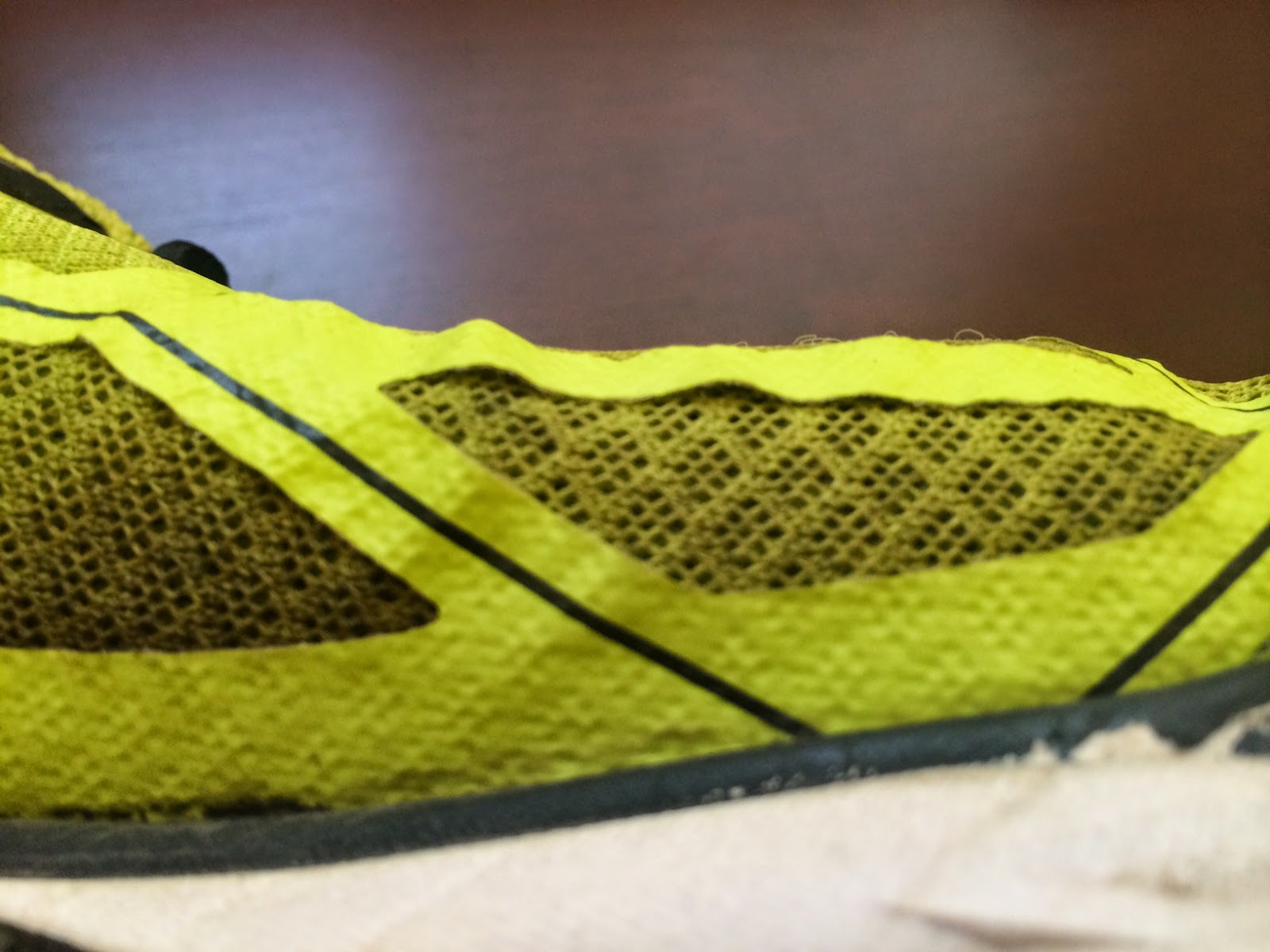
Overall, the uppers have held up very well, although frame is starting to delaminate from the mesh in some places.
Turning the shoe over, the rubber overlays are holding up great. However, the exposed foam near the front of the shoe has worn down significantly, and is starting to wear down elsewhere as well.
My biggest concern, however, is with the midsole. On the medial (inner) side of the insole, the foam is showing numerous compression lines.
However, on the lateral side it looks as good as new.
As a result, the shoes are starting to lean inward, and I can feel it when I run. I worry that pretty soon, they'll be putting me at risk for injury.
But to be fair, the midsoles may last longer for lighter runners (I am 190 lbs), or those with different running form.
While I love the Cliftons, at $130 I'm not likely to pick up another pair for use as a frequent trainer. However, I can't wait for them to go on sale.
Conversely, the Cliftons have not worked out quite so well as a shoe for long runs. At a slower pace, my heel sinks too deep into the cushion, and starting at around mile 10 I develop blisters at the front of my arch that I've never gotten with any other shoe. I've not been able to solve this problem with better lacing, and others have experienced the same problem: see here. Nevertheless, it's a fantastic shoe for the right purposes. (Here's Sage Canaday running 3 miles in 15:30 in his Cliftons).
When initially reviewing the Clifton, several reviewers, including myself, queried how durable they would be, given their insanely light weight. So, let's take a look:
Overall, the uppers have held up very well, although frame is starting to delaminate from the mesh in some places.
Turning the shoe over, the rubber overlays are holding up great. However, the exposed foam near the front of the shoe has worn down significantly, and is starting to wear down elsewhere as well.
My biggest concern, however, is with the midsole. On the medial (inner) side of the insole, the foam is showing numerous compression lines.
However, on the lateral side it looks as good as new.
As a result, the shoes are starting to lean inward, and I can feel it when I run. I worry that pretty soon, they'll be putting me at risk for injury.
But to be fair, the midsoles may last longer for lighter runners (I am 190 lbs), or those with different running form.
While I love the Cliftons, at $130 I'm not likely to pick up another pair for use as a frequent trainer. However, I can't wait for them to go on sale.
Friday, October 24, 2014
Friday, October 17, 2014
Carbo Loading Time!
I'm two days away from the Empire State Marathon, and so it's time to start turning my attention to carbo loading. I did some reading and thought I'd share what I found.
Perhaps the most interesting thing I found was an article in the NYTimes that cites a number of studies that claim that a short, intensive carbo loading the day before the race is the best method:
In both studies, carbohydrates eaten at breakfast on race day, during the race itself or on days earlier in the week were relatively unimportant. It was primarily what people ate on the day before the race that mattered.Okay, so focus on the day beforehand. Which can be a problem, given that I'll be travelling and away from my pantry. So what types of food should I pack or search out?
I often tell people to choose relatively concentrated sources of carbs, like juices, pasta, rice and sweets,” Mr. Wilson [a graduate student at the University of Minnesota who led the study] says. “That way, the volume of food needed isn't so enormous.” In addition, he says, “lower-fiber foods may be good, since that could reduce the potential for stomach distress during the race.”Dimity McDowell, writing in Runners World, provides me a detailed list:
"Tortillas, oatmeal, bread, pancakes, waffles, bagels, yogurt, and juice are all easy-to-digest options. Many fruits are high in carbs but are also high in fiber—and too much can cause stomach trouble midrace. "Bananas are a low-fiber choice," says sports nutritionist Ilana Katz, R.D. "And you can peel apples, peaches, and pears to reduce their fiber content." She also gives her clients permission to indulge in white bread and baked potatoes without the skin since both are easily digested.Cool - I can work with that. I absolutely love bananas and bagels anyways, so shouldn't be a problem. But how much should I be eating? The NYTimes article states that
Ryan suggests steering clear of high-fat foods—like creamy sauces, cheese, butter, and oils—as well as too much protein. Both nutrients fill you up faster than carbs and take longer to digest, she says. Pick jam—not butter—for your toast, tomato sauce in lieu of alfredo sauce on your pasta, and frozen yogurt instead of ice cream for dessert.
...few of the runners in either study actually consumed enough carbohydrates to benefit, even if they thought that they were doing so. In both studies, the minimum effective “dose” of carbohydrates was at least six or seven grams for every kilogram of a person’s body weight, or about a quarter-ounce of carbohydrates for every 2.2 pounds of body weight. By that formula, a 220-pound runner would need to consume at least 25 ounces, or more than 700 grams, of carbohydrates on the day before a marathon to finish faster.The Runners World article provides guidance along these lines:
At this point, 85 to 95 percent of your calories should come from carbs, says Katz. Ryan recommends eating about four grams of carbs for every pound of body weight (for a 150 pound runner that's 600 grams—or 2,400 calories—of carbs per day).What’s interesting is how this affects your weight:
Be prepared to see a number that's at least four pounds more than your usual weight. The extra pounds mean you get a gold star for carbo-loading properly. "With every gram of stored carbohydrate, you store an extra three grams of water," says Katz.I think I've got enough for a plan now. But i'm curious: what kind of foods you you carbo load on? Let me know in the comments!
Tuesday, October 7, 2014
Shoe Review: New Balance Fresh Foam 980
| image from runblogger.com |
I don't tend to write shoe reviews until I'm very sure of my opinion. I've already logged 200 (or so) miles on the Fresh Foam 980 at the writing of this review. Sadly, while I've learned a lot about the shoe over that period of time, one glaring fact stands in the way of me fully endorsing them: the fit. Fit is highly variable... makes sense, FEET are highly variable. For whatever reason, the designers at NB just didn't make a shoe with the 980 that fits my feet. I discovered this the first time I took them Fresh Foam on a long run, and ended up with blisters. I reaffirmed this the second time I did so with the same result (I very, very rarely get blisters otherwise).
While that pretty much assures I won't buy another pair, I do want to point out some of the positive things I like about this shoe; a shoe I still use for short runs on occasion:
1. It's got a 4mm drop with tons of underfoot protection. Massive.
2. I've heard folks mention the cushioning is very stiff. From my standpoint, this is a good thing. My feet feel very protected, the shoes are plenty plush and they are responsive enough to handle any paced running. Tough to have all of those things at once, in my mind.
3. The upper is light, but doesn't seem fragile. In fact, the shoes look quite new even after 200 miles.
On the flip side:
1. The tongue is absurdly puffy and bothers the tops of my feet, moves around during the run.
2. The "fit issue" for me is related to the narrow toe-box. Widen it up, NB!!
All-in-all, its a well-cushioned, light, low-drop shoe that, provided it fits, will get you through the miles at any pace you choose.
Friday, October 3, 2014
Marathon Nutrition Strategy
One of the challenging aspects about the marathon is how to take in energy as you're running. This is important, because as Sara Latta's article details, most runners only have ~2,000 calories worth of glycogen stored in the muscles and liver, enough to get you to about mile 20. Once you deplete your glycogen reserves, you hit the Wall, where your body moves from burning glucose to burning fat, a much less efficient energy source. Latta writes:
I've tried a few things over the years. These include:
My tactic will be to rely mainly on chews and water. While I’m going to carry a GU or two with me, in case I need big boost of glucose for the later stages of the race, i'm going to avoid it if I can.
What do you think? What worked for you? Send along any advice you have in the comments.
Related Posts:
Don't Drive the Boat: My Nutrition Strategy for TNF 50 DC
To Supplement or Not to Supplement
"...burning fatty acids requires plentiful oxygen, so as fatty acid metabolism increases, your heart must work harder to pump more oxygen-carrying blood to the muscles. It may be difficult or impossible to maintain your pace, especially if you've lost enough water through sweat to become even slightly dehydrated (this causes your blood to become thicker and therefore harder to pump). ”Sounds unpleasant! And it is - I've been there. Your limbs feel heavy and the mind becomes stagnant as the body focuses its energy elsewhere. So the trick is to take in enough glucose during the run to prevent or delay this turnover as long as possible. As someone that has a tricky stomach, this has been a challenge for me. How to best replenish my reserves as I run without sparking GI?
I've tried a few things over the years. These include:
- Acceleraide. Typically, I've drank the Orange flavor in my hand-held, but have also used other other sports drinks like Gatorade, etc. This appears to be effective, but I've encountered two issues with these sports drinks:
- Sweet. After a while, the thought of drinking more flavored drink is just nauseating – I just want water! Wish there was a way to carry just a shot or two with me.
- Sour stomach. All of the carbs in the liquid doesn't always sit well.
- Gels. These are the most efficient method for immediate energy that I know of. I've used a number of different flavors and styles, but have mainly stuck with GUs. My issues with them are:
- Flavor. These can range from horrible (Salted Watermelon!) to excellent (Salted Caramel!)
- Caffeine. While at times it’s nice to have this added energy, caffeine can upset my stomach, especially on a relatively empty stomach on early morning runs.
- Too quick? At times, the energy hits me so quickly I sometimes feel shaky or jittery.
- Chews. My favorite. I find that the chews are a good balance of energy and slower digestion. My only issue here is that they’re very sticky and bulky, so not always easy to carry around.
My tactic will be to rely mainly on chews and water. While I’m going to carry a GU or two with me, in case I need big boost of glucose for the later stages of the race, i'm going to avoid it if I can.
What do you think? What worked for you? Send along any advice you have in the comments.
Related Posts:
Don't Drive the Boat: My Nutrition Strategy for TNF 50 DC
To Supplement or Not to Supplement
Monday, September 29, 2014
LLS and the Empire State
In three short weeks - October 19th - I'll be running in the Empire State Marathon. I've decided to do so as a member of The Leukemia & Lymphoma Society’s (LLS) Team in Training program in order to help find cures and ensure access to treatments for blood cancer patients. So I've set up a little widget in the right corner of this blog - anything you can spare would be appreciated. (Mobile users might need to view the standard webpage.)
Some history: my wife was diagnosed with an aggressive form of Lymphoma last year. While she has since eradicated the disease (after undergoing an unpleasant chemotherapy program), the whole experience was extremely scary. The LLS website was one of the few calm, objective sources of information that helped us get our minds around what we were dealing with in the initial dark days after the diagnosis.
Since the recovery, I strive to continually be grateful for my family's health, and recognize how lucky I am to spend absurd amounts of time running outside. So it only seems right that I spend some of that time trying to help those that aren't as lucky. The LLS does excellent work funding treatments that save lives every day; like immnuotherapies that use a person’s own immune system to kill cancer. I was beyond impressed how the oncologist was able to customize a chemo "cocktail" to address my wife's specific form of lymphoma. LLS helps give doctors these tools.
So if you can, send along what you can to help us get closer to a world without blood cancers. Any money I raise will be matched by my company - so anything you give will be doubled! If you don't have any money to spare, no worries - I get it. Thanks for your attention, and i'll be sure to let you know how the run goes!
Some history: my wife was diagnosed with an aggressive form of Lymphoma last year. While she has since eradicated the disease (after undergoing an unpleasant chemotherapy program), the whole experience was extremely scary. The LLS website was one of the few calm, objective sources of information that helped us get our minds around what we were dealing with in the initial dark days after the diagnosis.
Since the recovery, I strive to continually be grateful for my family's health, and recognize how lucky I am to spend absurd amounts of time running outside. So it only seems right that I spend some of that time trying to help those that aren't as lucky. The LLS does excellent work funding treatments that save lives every day; like immnuotherapies that use a person’s own immune system to kill cancer. I was beyond impressed how the oncologist was able to customize a chemo "cocktail" to address my wife's specific form of lymphoma. LLS helps give doctors these tools.
So if you can, send along what you can to help us get closer to a world without blood cancers. Any money I raise will be matched by my company - so anything you give will be doubled! If you don't have any money to spare, no worries - I get it. Thanks for your attention, and i'll be sure to let you know how the run goes!
Sunday, September 28, 2014
Subscribe to:
Posts (Atom)
.jpeg)


.jpg)


.jpeg)
.jpeg)
.jpeg)
.jpeg)
.jpeg)
.jpeg)
.jpeg)
.jpeg)