Analyitics

Showing posts with label Shoes. Show all posts

Thursday, April 23, 2015

Nike LunarTempo

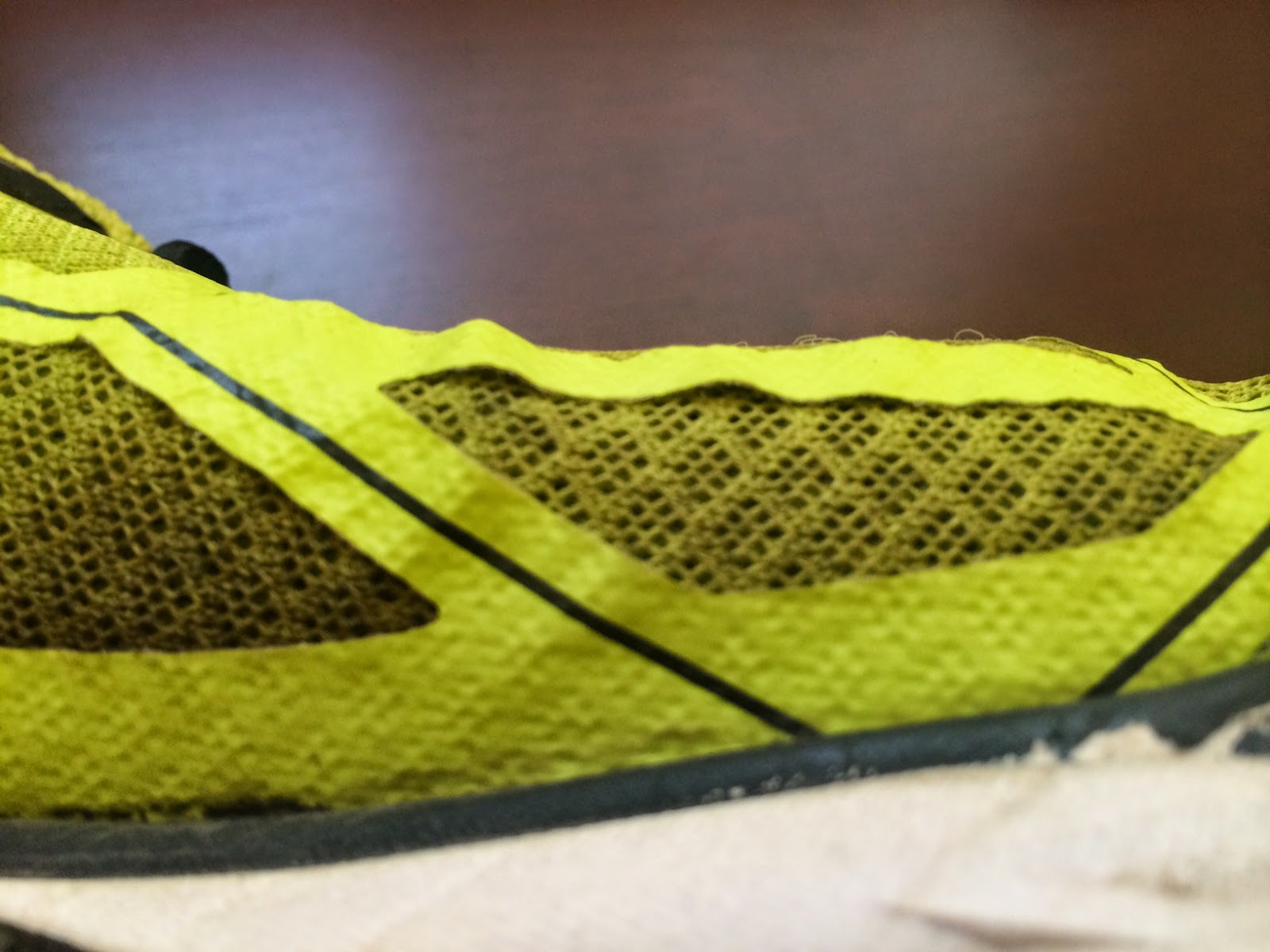
After only 39 miles, the shoe on the right isn't looking so vertical.


No obvious signs of collapse along the medial edge though.  Hmmm....

Wednesday, November 19, 2014

Shoe Review: Nike Zoom Fly

The last time I was in the market for a new shoe, I wanted to try something different than my standbys - the Saucony Guides and Brooks PureCadence. In my online searches, the Nike Zoom Fly kept popping up as a shoe I might be interested in. Fascinating, captain - I had never thought of Nike as a serious running shoe producer, believing them as either a style or basketball shoe company. But the shoe sounded just like what I wanted, and was very reasonably priced. So I took the leap, having run in them three times. My reaction?
  • Good, if not great, fit for my feet. Roomy toebox, perhaps a tiny bit looser in the heel, but nothing that has been detrimental.  
  • There's a touch of support for us pronators.
  • Stiff sole. I'm hoping this loosens up a bit over time, but for the moment I would only want to take this on flat roads or the track,
  • Doesn't have as much cushion as I'm used to. Not a big issue, but I'm used to the softer forefoot of the Guide and PureCadence.
  • Light and fast. Feel very speedy in these shoes.
  • Stylish! I love how these look. Great colors. Not too much busy visual design like 99% of the rest of the current running shoe market.
Overall I can't say these are my favorite shoes but I do like them - and will like them even more if the sole loosens up a bit. Given that the price is extremely reasonable ($65 on sale at Running Warehouse), the Zoom Fly is a great value. 

Those of you interested in technical details, click here for more.

Wednesday, November 5, 2014

Hoka Clifton - Durability Update

This morning, I reached 150 miles on my Hoka Cliftons.  The miles accumulated far more quickly than I expected, as these are the shoes I reach for whenever I want a fast run with quick leg turnover and without having to think about my feet. 

Conversely, the Cliftons have not worked out quite so well as a shoe for long runs.  At a slower pace, my heel sinks too deep into the cushion, and starting at around mile 10 I develop blisters at the front of my arch that I've never gotten with any other shoe.  I've not been able to solve this problem with better lacing, and others have experienced the same problem: see here.  Nevertheless, it's a fantastic shoe for the right purposes.  (Here's Sage Canaday running 3 miles in 15:30 in his Cliftons).

When initially reviewing the Clifton, several reviewers, including myself, queried how durable they would be, given their insanely light weight.  So, let's take a look:

Overall, the uppers have held up very well, although frame is starting to delaminate from the mesh in some places. 


Turning the shoe over, the rubber overlays are holding up great.  However, the exposed foam near the front of the shoe has worn down significantly, and is starting to wear down elsewhere as well.


My biggest concern, however, is with the midsole.  On the medial (inner) side of the insole, the foam is showing numerous compression lines.  


However, on the lateral side it looks as good as new.


As a result, the shoes are starting to lean inward, and I can feel it when I run.  I worry that pretty soon, they'll be putting me at risk for injury.
 

But to be fair, the midsoles may last longer for lighter runners (I am 190 lbs), or those with different running form.

While I love the Cliftons, at $130 I'm not likely to pick up another pair for use as a frequent trainer.  However, I can't wait for them to go on sale. 
 

Monday, September 22, 2014

Mizuno Wave Hitogami 2

The Mizuno Wave Hitogami is a brilliant shoe for fast paced running.  Plus, with a MSRP of under $100 -- and several stores selling them for $75 or less -- the price is certainly right.

Aesthetically, though, they're a bit of a disaster (not that that will keep me from running in them).  Yes, I get it, if you take the left and the right shoe and line them up just so, they sort of look like a Japanese kabuki mask.  So, Mizuno added a bunch of extra overlays to create a feature that has nothing to do with running and that nobody will ever see, just for the sake of a talking point?  Add on top of that the generally clown-like colors, and I just wasn't impressed.

Luckily, Mizuno will be abandoning all of that for the Wave Mizuno 2, overhauling the upper to create a shoe with an aesthetic closer to that of the now-discontinued Wave Ronin series.

Coming in January 2015, the Hitogami 2...


Tuesday, June 25, 2013

And the winner is . . .

When you are running for half the day at an ultramarathon pace, the shoe with the best technical features may not be the best shoe for your foot.  Having learned this lesson the hard way, I began to shop for a cushioned trail shoe.

I narrowed down my choices to five shoes that have gotten excellent reviews.  Unfortunately, those reviews don't tell me how the shoes compare to each other in terms of cushioning, flexibility, and other factors.  So, I bought all five from Running Warehouse so I could try them all on . . .  and then send four back for a refund.

From top to bottom, Asics Gel-Fuji Trainer 2, Asics Gel-Scout, Brooks Cascadia 8, New Balance 1210 Leadville, Montrail FluidFeel
Since the purpose was to compare these shoes, I've ranked them against each other on the following factors:

Cushioning: The rankings simply indicate how much cushioning each shoe has, and not on which is best.  Different people like different amounts.  1 indicates the least, and 5 indicates the most.

Protection: After stepping on a variety of household objects, I have tried to anticipate how much protection each shoe will provide from rocks and roots on the rail.  Again, 1 is the least, and 5 is the most.  More protection means less road feel, so again, these are not rankings of which shoe is better.

Flexibility: Easily determined by twisting the shoe in various directions with my hands.  1 is the least flexible, 5 is the most.  (Do you sense a pattern?)

Width:  1 indicates the narrowest shoe, while 5 indicates the widest.  There was very little difference between the shoes ranked 3-5, so those rankings should be taken with a grain of salt.

Weight: From the lightest to the heaviest.

Note that I have not run in these shoes, and have no idea how grippy they are, how well they drain, etc.  The purpose of this test was simply to try them on and compare how they feel on my foot, since to me that is the most important factor over a long, slow race.

Asics Gel-Fuji Trainer 2
Cushioning: 1
Protection: 1
Flexibility: 4
Width: 3
Weight: 1
Notes:  This shoe feels "barely there" while still offering more protection underfoot than more minimalist shoes.  A tempting shoe, but they're not going to take me on much longer runs than the Inov-8 295s that I already wear.

Asics Gel-Scout
Cushioning: 3
Protection: 3
Flexibility: 2
Width: 5
Weight: 5
Notes: A exoskeletal heel counter, a visible gel pod in the sole, durable layers of mesh, a pocket for the laces on the tongue: this shoe is loaded down with visible technology.  Although it feels extremely stiff in my hand, it is somewhat more flexible when on my feet.  While it doesn't stand out to me, it is a comfortable, protective shoe that could appeal to many.

Brooks Cascadia 8
Cushioning: 4
Protection: 2
Flexibility: 3
Width: 4
Weight: 4
Notes:  Aaaaah!  Brooks has nailed it.  This shoe fits my foot beautifully.  The cushioning is softer than in any other shoe, perhaps a bit too soft for my tastes, but it will feel great over a long day on the trails. Now I see why these shoes are so popular among ultrarunners.  The one downside is that they are the most expensive of the shoes I'm trying on.

New Balance 1210 Leadville
Cushioning: 2
Protection: 5
Flexibility:  1
Width: 2
Weight: 2
Notes:  In my hand, the materials feels plasticky -- maybe that's why this shoe manages to be so light.  The upper feels fantastically comfortable on my foot.  As for the sole. . . while this shoe has a LOT of sole, it isn't very soft.  In fact, it feels stiff as a board under my foot.  I just can't imagine running in these.  But, stepping on household obstacles, I barely feel a thing.  A shoe only for those who want maximum protection.

Montrail FluidFeel
Cushioning: 5
Protection: 4
Flexibility: 5
Width: 1
Weight: 3
Notes: Out of the box, I didn't want to like this shoe -- it is so damn ugly.  But in my mind, this is exactly how a long distance running shoe should feel.  Lots of resilient, but not squishy, cushioning; outstanding protection, and somehow still an extremely flexible shoe.  Unfortunately, despite having a very wide, stable base, the fit is much, much too narrow for my foot.

Any of those shoes could be great for someone, but the winner (for me) is -- the Brooks Cascadia 8!

Wednesday, January 23, 2013

Moving Towards Flatter Shoes


The 4 mm difference in heel-toe drop between my new shoes (Saucony Guide 5) and my standard (Brooks Adrenaline) took me off guard. My first run was actually quite difficult, as I felt significant stress in my shins and calves as well as - surprisingly - my hips after this run. The main difference, detailed here, is that the incredible cushioning of the shoes pretty much force you to land on your mid to fore-foot so I did some research to determine what exercises and/or stretches would help me transition to a different foot landing.

The best guide I found for determining if you are ready for “minimal” running was this excellent article by Jay Dicharry, a physical therapist and director of the Speed Lab at the University of Virginia. (Here’s a bonus summary of the article.) So I did his test and passed all three (thank you Yoga!):

  1. You have to be able to isolate and control the flexor hallucis brevis. This is not an intuitive move for me, but I was was able to do it. 
  2. Demonstrate ankle and plantar fascia mobility.
  3. Single leg balance. 

(BTW, Jay's book Anatomy for Runners, sounds like a must-read.)

So according to this, I have the ability to run with a reduced heel-toe drop. But it still felt really awkward. What to do? Here’s my plan of attack:

  • Foot massage. If you visit me at work, make noise as you arrive because odds are I have my shoes off and am massaging the bottom of my feet with a tennis ball. Doing this has helped my foot strength immeasurably.
  • Toe lifts. An exercise typically used to prevent shin splints (I can attest to this!), you can simply stand with your back against a wall, heels a few inches away from the wall. Then slowly lift your toes up as far as you can, 10-15 times. (Just like this, although I typically do it on a flat surface not a platform.) Repeat 2-3 times if you can, but due to time constraints, I usually only get 1-2 cycles in. 
  • Calf Stretching. I try to stretch out each calf for at least 20-30 seconds. (I’m sorry, but I’ve tried and failed at holding stretches for three minutes
  • The Stick/foam roller. I swear by this. I roll my calves with either the stick or the foam roller after every run – and sometimes both. (The foam roller is also great kid entertainment: I roll my muscles, and then the older ones put it over their arm and play superhero while the infant tries to chew it.) 

So far it’s been working. I ran a decent-paced 5 miler today with no discomfort at all! I'm hoping to wear the Guides for a long run (10 miles) by March, if not sooner. If anyone has some other exercises they recommend, i'm all ears!

Related Posts:
Improve your running form
Foot Strike Fads:
My never final say on barefoot running

Wednesday, January 16, 2013

First Impressions of the Saucony Guide 5

I made my first foray away from the traditional running shoe dimensions by picking up a set of Saucony Guide 5s. Until now, I've been alternating between the Brooks Adrenaline and Saucony Guide 4, both of which are over 11 oz and have a 12 mm heel-to-toe drop. By contrast, the Guide 5 weighs 10 oz and has an  8 mm heel-to-toe drop.

I'm going to wait until I've run longer in these shoes to totally geek out about them, but here are my first impressions:
  • The 4 mm heel-to-toe drop makes a huge difference. I feel very strange running in them, since the lack of suburb heel cushioning does force you to land more on your front foot. More on this in a future post.
  • The cushioning in these shoes - concentrated in the mid and front foot - is simply sublime. Feels like wearing a shoe with space-age padding!
  • I’m not completely comfortable in these shoes yet, because I feel like I need to increase my shin and calf strength in order to change my foot strike. Again, more thoughts on this in the near future.
In short, my first impression is that it's an amazingly comfortable shoe with moderate stability features designed to promote a forefront stride. I'm happy I bought them, but we'll see how effective they end up being. I'll report back after 50-60 miles in them.

Wednesday, August 1, 2012

Shoe Review: Asics Gel FujiRacer

Buying running shoes isn't getting any easier.  Am I getting too much shoe?  Too little?  Am I spending too much for too little?  What is the right shoe for road?  For trails?  For mountain trails?  The list of questions goes on.  Given that I've been focusing much more on trail running (preferably with steep hills) lately, I thought it would be a good idea to put a pair of shoes on my feet that would suit the terrain I was running on.  This was after having run plenty of miles on the trails in my go-to shoe, the Brooks PureCadence.  The experience running in those shoes left me wanting a bit more traction on trails and a bit more protection from the plentiful rocks and roots New England trails have to offer.  After much deliberation, a bit of pure confusion at all the options out there, I opted for the Asics Gel FujiRacer.

The reasons for selecting this shoe were due to their similarity in specs to the PureCadence, light weight, low heel-to-toe differential (6mm), low profile.  Why not get the Brooks PureGrit, you say?  Well, given that I was looking for traction (PureCadence's biggest flaw) and protection (PureGrit have no rock plate) I made up my mind, closed my eyes and clicked buy (Running Warehouse makes it incredibly easy to buy shoes with their very liberal return policy).

It takes me a while to figure out whether I like shoes or not.  I've put in about 80 miles on these shoes so far, including a 19 mile outing in the White Mountains with lots of up and down and plenty of mileage on local trails.  

My first impression of these shoes upon putting them on was that they didn't fit.  I got a size 11.5, as is standard for me in any shoe.  It was very snug, tight in fact, when it first put it on.  I had read that I should buy a size up, but it's kind of hard for me to do that...  I've never had a size 12 shoe feel right on my foot (nor a size 11 for that matter).  Hoping they would stretch out a bit, I didn't send them back and set about running.

They did break in a bit, maybe even too much.  Surprisingly, after a few runs, I felt my feet moving around more than I was comfortable with in an otherwise narrow feeling toebox.  This was completely unexpected.  Granted, I sweat A LOT, and my feet were completely soaked when this happened (thus contributing to the slipperiness), but it's certainly on the negative side of how these shoes feel (especially descending a mountain, when you really want to trust your foot plant).

One of the most prominent things I noticed about this shoes is how ridiculously light they are.  This makes climbing an absolute breeze.  It's one of the absolute best features this shoe has to offer...  I found myself going up things I would have normally trudged up in hiking boots with ease i was unaccustomed to.  Asics have gotten this light weight a couple different ways:

Here is the bottom before a run, note the holes and nice tread
1. The outsole, rock plate and midsole of this shoe literally have holes cut in them all the way through the shoe.  If you take out the insert, you can see through the thing layer of fabric.  This is at once very smart, and certainly encourages quick drainage, but also allows things to come in rather easily as well.  The things that end up coming in are:  dust and dirt, small rocks, mud, especially placed sticks (rare, happened once) and most shockingly, water.  I say shockingly because the first time i stepped in a stream, the water was on the bottom of my foot before I knew it and it gave me a start.  But it also went right back out.  You can easily see the positives and negatives of this design, but after having put the shoes through the paces, i'm fine with the dirt, mud, rocks and what have you...  and I *would* be fine with the water, were it not for a pretty important traction issue.  Much like the PureCadence, when the outsole of this shoe gets wet, it will not grip any hard surface.  If you sweat like i do, soon into a humid summer run, those holes in the shoe will let the sweat get on the bottom of your shoes, stream or not.  This is an issue that must be addressed in the next revision of the shoe.  I will say that the traction is otherwise awesome.  The shoe will climb you easily through dirt, mud, and does great on the other surfaces when dry.  But when wet, be careful descending quickly where you put your feet...  one slight off kilter plant on a rock and you'll be picking yourself up from the deck.
here is the bottom after a run in dry conditions (yech, that's sweat!)

2. The shoe has much less cushioning than a tradition trail shoe, or even a traditional road trainer.  The interesting thing about this is that the shoe does have asics' patented gel in the heel.  You can really feel this any time you come close to a heel strike.  The forefoot of this shoe and the heel are night and day.  The difference in cushioning is especially noticeable compared to the PureCadence.  At first, this was very hard to deal with, as my feet were taking a pounding.  I came to realize realize just how NOT minimal the PureCadence are as I continued to run in these shoes (which are also NOT minimal).  The proprioception in the forefoot area of this shoe is great..  You really are in touch with the ground.  It does call for a much more deliberate style of running... but this type of running will help you keep from rolling your ankle or taking a digger.  It takes some getting used to, and I'm still not sold that the forefoot has enough cushioning, but I will say I'm going to continue to wear this on long mountain runs with steep descents, at least until I figure out another trail shoe to buy.

There isn't much else to this shoe, which I guess is another factor in the light weight of it.  The upper feels fine.  It has taken some serious beatings in the runs I have done and shows no sign of being worse for the wear (despite being quite dirty).  I do think it has a bit too much "flex", resulting in the fit issues I described earlier.

Of all the factors to consider in shoes, I think fit is very personal.  That the FujiRacer doesn't fit me perfectly will probably prevent me from buying the next revision of this shoe.  If they fix the traction issue, and if you are looking for a light weight trail shoe that will stand up to the punishment if a very long day on steep, rocky trails, this really is a great shoe.  If you aren't used to a less-than-plush forefoot cushion, it may take some time to get used to these shoes, but I think your running could benefit from it if all other factors are acceptable and you give them a chance.

If you have any additional questions or thoughts, definitely let us know!


Tuesday, April 17, 2012

Shoe Review: Brooks PureCadence, 400+ miles later

Back in November, I wrote a review of the Brooks PureCadence running shoes.  At that point in time, I was very happily surprised with my whimsical purchase of these shoes.  So now that I've logged over 400 miles, how have they held up?

I must say, absolutely great!  I've included a picture of them to the right.  To reiterate some of my initial concerns, I was worried these shoes wouldn't last much more than a couple hundred miles.  My initial review was at about 30-40 miles and I had noticed some significant wear in the shoes at that point in time.  But as you can see, I've gone over 10X that far in this pair and they have held up quite nicely.  That has included everything from 20 mile slogs on the Charles River, 10 mile trail runs over roots, rocks and what have you and up and down 9+% graded hills, both paved and otherwise.

My biggest concern with these shoes was whether they would hold up, and they certainly did.  I do have an important comment I'm hoping the folks over at Brooks will listen to however.  These shoes served me well in most running conditions.  One situation, however, they failed to perform well, and that was rainy, slick runs on urban streets.  When i say urban streets, i mean any street/sidewalk/running surface that has man hole covers, iron grates, or any metal of any kind.  To take it even further, and for the sake of clarity, let me say that the PureCadence version 1 shoes do not grip all that well in wet conditions on any hard surface.

Beyond that, however, I really don't have any negative comments whatsoever.  I wear the PureCadence on all of my long runs and all of my "key runs", meaning, any tempo work or other essential workouts.  I spent two months prior to strapping them on injured and unable to run.  I'm not going to claim that the PureCadence fixed my ails...  I'm pretty sure it was the countless repetitions of daily exercises geared and strengthening my lower legs...  but I can say, I wear the PureCadence when I fear injury the most, because they are the most trustworthy shoe I own and I have never had an issue with them unrelated to traction.

After a run in my other regular running shoes it is a pleasure to put my feet back in the PureCadence.  To reiterate, my favorite features are the following:


  • The last of this shoe fits my foot like no other shoe I've ever put on.  It literally feels like an extension of my foot.
  • Having had an extensive background in shoe-less exercise, the 4mm heel-to-toe differential allows me to harness my leg's strengths in a much more natural feeling way.
  • The biomogo provides very comfortable cushioning while still allowing for you to gain some sense of proprioception, allowing for a more natural engagement on each footstrike, regardless of what part of your foot hits the ground.
  • The support in these shoes is not overwhelming.  I've got some crazy movement when my foot hits the ground...  like it or not.  I do like a bit of support, and I think the PureCadence provide that but leave it up to me to ensure I'm running with good form.  I don't want to be controlled, but I also don't mind a helpful reminder at mile 20 that it's a good idea to keep my form in check.
  • I've never run in a shoe that is so light.  Once you try a shoe as light as this one, you'll never, ever go back to those big 'ol clunkers we all used to train in.  It really makes a difference.
  • Seems simple enough, but the laces are standard up through the eyelets to allow for ease of tightening and loosening, but are fashioned in a wave-like "stay-tied" manner in the upper section, translated into, well, laces that stay tied on your run.  Laces that stay tied are good.
  • The shoe just plain fits my foot.  Heel to toe.  I don't know if it's a stroke of luck, that the designers and testers had feet like my own, or not, but it cannot be denied.  It feels like these shoes were made for me.

On their website, Brooks indicates the PureCadence should last you about 250 miles.  Clever marketing for such a popular shoe...  and as previously stated, my initial worry was that Brooks was right.  I was hooked on these shoes, and I was afraid I'd be paying the hefty price for them every couple of months.  But the truth is in the testing, and after 413 miles, I'm happy to say I've purchased my second pair of these running shoes. When it comes time for me to run the Burlington Marathon in May, I'll have them on my feet.  And in October, when I run Annette Bednosky's amazing New River Trail 50K, i'll have them on as well.

Related Links:
Shoe Review: Brooks PureCadence

Thursday, January 19, 2012

the "New Shoe Effect"

i'm amazed at how many shoe reviews contain statements like "i ran 30 seconds per mile faster" or "i took 10 minutes off my time for 10 miles".  these statements aren't just about running faster, but significantly faster, on the first run with a new pair of shoes.

i wonder what it is that causes this to happen?  surely it's mental...

maybe we here at rrrs should invent some token disposable "per run" add-on to shoes that will tap into that mental fuel tank and allow people to harness it more regularly?

strapping on a new pair of shoes myself for tonight's run...  will i be faster?

Saturday, January 14, 2012

Keflezighi's Skechers

So.  The 36-year-old Meb Keflezighi won the Olympic marathon trials in Houston today, with a personal best time of 2:09:08.

First reaction: He's 36 and still setting personal bests?  So what's my excuse again?

Second reaction: Maybe it was the shoes.  Figure out what shoes he was wearing.  Wait . . . he was wearing the new Skechers GoRun?  Really?

OK, the dude could run fast in anything.  But I'm intrigued.  Perhaps not yet intrigued enough to pay $80.  But if anyone wants to loan us a test pair . . . .

Tuesday, December 27, 2011

Recycled Treads


It’s not well publicized that shoes are horrible for the environment. As Grist sez: “Shoes are usually a mix of many materials: 40 materials in a typical shoe, don't you know. Pollutants derived from the making of a shoe could include dioxin, volatile organic compounds, solvents, chromium, hide waste effluent, and isocyanates.” 

Since I consider myself both an environmentalist and a runner, so I try to keep my footprint as light as possible in more ways than one. This is easier said than done. However, this month’s Sierra magazine has helped me sleep a little better – they've listed not one but two sites where you can go to recycle your old running shoes:

In the Boston area, both sites pointed you towards the Nike outlet in Wrentham, MA. Nike recycles any brand of sport shoes by grinding them up and turning them into either squishy surfaces for athletic tracks or new shoes. They've recycled 25 million pairs since 1993, which is admirable, but Sierra reminds us that is but only a fraction of the 40 million pairs of athletic shoes that are recycled every year, so there's a way to go.

Wednesday, November 30, 2011

Shoe Review: Brooks PureCadence

I've posted a follow-up review of these shoes after 400+ miles in them that you can find here: http://readingrunningredsox.blogspot.com/2012/04/shoe-review-brooks-purecadence-400.html

i've been through a LOT of shoes over the years, especially this year.  like most people who care about these things, my head is all mixed up about whether i should be looking for more technology, less technology, more shoe or less shoe.  i made a decision a while back to forget about all that and simply go with what works.  how great, in theory...  but the opportunity to truly test out each and every shoe just plain isn't going to happen.

this year, i've run on neutral shoes, motion control shoes, stability shoes, barefoot and stability shoes.  i realized, from all this, that i need at least some stability technology in my shoes.  the comes into play for me on longer runs, when i get fatigued and have a tendency to lose a bit of my running form.  i am an over-pronator with high arches.

Todd runs the Brooks Adrenaline and seems to like them, so i thought i'd give them a try.  when i tried to order them, however, they were somehow out of my size at the price i was looking for, and so, out of frustration and a penchant to be swayed by good marketing, i bought the Brooks PureCadence instead.

i wanted to give the shoes enough of a sampling before i passed any judgement on them.  i will say, however, that after the first run i was totally in love with them and have since only increased my affection for them.

let's be clear about what these shoes are.  Brooks have not one time included the word "minimal" in any of the descriptions i have found on their website for these shoes.  if you read people's comments about these shoes, however, you'll see the words "minimal" and "barefoot" come up a lot, and i'm pretty sure, for marketing reasons, Brooks is willing to ride that wave.  these shoes ARE NOT minimal nor anything similar to "barefoot" (that should be pretty obvious).  they ARE low-profile, low-heel-drop (4mm) and light-weight (9.5 oz) shoes suitable for short and long runs,   that also have ample cushioning and stability control.

my assumption after purchasing these shoes was that i would use them for shorter runs and then get a pair of adrenalines to wear on my longer runs.  so far, even with the vast sneaker collection i already have, i have not worn another shoe on any run i've done since i put these on my feet, nor can i imagine doing so.  the combination of the low-profile/low-heel drop/light(ish)weight with the stability control features makes this shoe somewhat unique in the market.  i don't know of another shoe that gives you what many would consider to be somewhat opposing features in one package.  but the result is amazing.  the low heel drop, which i thought would further tighten my calves, seems to ease them, allowing for much more ankle flex in my stride, a much more natural feeling. the light weight allows me to increase my cadence (purely) and keeps my legs fresher throughout the run.  the lower profile gives me a much better feeling from toe to heel when i come in contact with the ground, a much more solid and confident strike.

i have a pretty narrow foot, and the fit of these is quite good.  i could imagine the shoe being a bit too narrow for runners with wider feet, and i don't think they offer wider sizes yet.  i like the inclusion of the "nav band" which does make the shoe fit my foot more nicely.  all in all, the shoe feels REALLY good on my foot...  the fit is great and the shoe is so much more comfortable than i would have anticipated and sincerely as comfortable if not more so than any other shoe i've ran in.

when running in these shoes, the constant questions, tweaks and adjustments working through my head and body when i run in other shoes go away.  i find that i settle into the form i want to be in, the stride and strike i strive for naturally, as if the shoes were custom made for me.  this is a huge endorsement from me!  i don't know if it's a result of the technology being really good, or simply that there is less technology that makes this shoe work for me, but even towards the end of my longer runs in these shoes, my form feels stable and strong, even when my legs don't.  i will say, however, that i have rolled my ankle twice in these shoes...  i WAS running on uneven terrain in the dark, but i haven't done that in a long time in any other shoe.

i had originally questioned whether or not i thought these shoes would be cush enough to last through a marathon, but i do believe they will.  i haven't taken them over 8 miles yet though, so i'll be sure to report back if there is any issue when i do.

on the downside, i don't think these shoes are going to last me very long.  i've only put 30-40 miles in on them and they are already showing some signs of wear.  additionally, the "split toe" feature seems like a good idea, but on my shoe, the gap on the left side is (much) smaller than the gap on the right side, leading me to believe they aren't constructed as well as they could be.  (i have yet to experience anything new with this "split toe" feature either).  for a shoe as expensive as these are, i would hope they would last a decent amount of time and being well-constructed.

still, my primary thought right now is:  how do i make sure i am always able to run in these shoes.

Related Posts:
Review: Brooks Launch
Shoe Review: Asics Gel-Bandito
Kinvara 2 Review

Friday, October 14, 2011

Review: Brooks Launch

Since y'all asked about those flashy shoes I was wearing at the 50K:  those are the Brooks Launch.

The Brooks Launch first came on the market late in the summer of 2009, immediately winning "Best Debut" from Runners' World.  This was right about the time I started running, and even though I was hearing lot of buzz about these shoes, I was worried that they might be too minimal starting out, so I began running in the Brooks Glycerin.

Happily, Brooks has not updated an already great thing: there is no "Brooks Launch 2."  They've simply changed the colors.  I bought my first pair of Brooks Launch in the summer of this year, and despite a variety of other shoes under my bed they quickly became my go-to shoe.  Shortly before the 50K, I retired my old black pair for a new pair in blue and silver (the best color scheme yet, in my opinion.)  Other than the laces, they are not quite as bright as they appear on some stores' web sites, and once you get them a little dirty, the color tones down even more.

The Launch is a lightweight, neutral shoe.  It isn't a minimal shoe by absolute standards, but it is relative to my old Glycerins.  It's weight comes in at just a feather over 9 oz.  According to the Brooks website, the shoe has a 9.5 mm heel-to-toe offset, while Running Warehouse measures it 12 mm.  Perhaps the difference is because the measurements were based on a different size of shoe?  In any case, that's less heel than the Glycerin, but more than the Green Silence.  For me, it was just the right amount of padding for a 50K on a soft surface -- I never thought about my feet at all during the run. 

I also appreciate the lightweight upper.  My feet don't even get damp when I run, which is a complaint I've had with many other shoes.  That, together with the roomy toe box, means I don't get any of the blisters that typically develop with other shoes.  (In fact, they only blister I got at all during the 50K was a on the middle toe of my left foot, and I don't blame that on the shoes.)  I once got caught in a rainstorm while running, and was pleased to find that the shoes drained easily, and that my feet were again dry soon after the rain ended.

The soles of the Brooks Launch have certainly proved to be more durable than the Kinvara 2s I ran in for a while.  As for the cushioning, though, they started to feel somewhat flat after 200 miles, which is the reason I bought the new pair.  I do weigh 190 lbs., but I wish I could get  more miles out of them.

My only other complaint is that I tend to get a good number of pebbles in my shoes when running off road; during the 50K I had to stop once to shake it out.  I'm not quite sure why this should be so -- perhaps it is being picked up in the soles of shoe (which contain a lot of narrow grooves) and then dropped in?

Other than that, though, they are super comfortable--soft on the inside, good laces, no pressure points, very flexible.  They're great for an easy trail ultra, and just as great for a 5K.

Finally, a shout-out for the fact that these shoes are relatively environmentally friendly, as far as running shoes go.  Kudos to Brooks for its use of recycled elements and for its work on developing biodegradable materials.

Any questions?

Monday, October 3, 2011

Graphical Arch Support

I may not always be the most observant person, but this one takes the cake. As long as i've been running, I never noticed that the arch support of most shoes was represented by the gray coloring on the side. Check out the two shoes I bought this weekend, and see how the arch support on the Brooks Adrenaline 11 extends farther backward into the heel than the Saucony Guide 4:
The Brooks Adrenaline 11
The Saucony Guide 4
Did you know this? Makes me feel foolish that I didn't recognize this before. Regardless, I'll let you know how the difference between the two supports feel once I get them out on the road.

Thursday, September 29, 2011

Time For New Shoes

I'm currently running in the Brooks Adrenaline 10 (link is to the updated version). I've been very happy with how they've felt, but it's time for a new pair; i've been feeling the shoe flatten out over the last few weeks. My dilemma is that I have a sweet coupon for Sauconys, and it sounds like the Saucony Omni ProGrid is the equivalent in that brand. I'm heading to my local running store tomorrow to try them on, but wanted to see if either of you had any opinions. I think I prefer a shoe with more stability then either of you, but would welcome any ideas/feedback you might have about the two brands.