Analyitics

Showing posts with label review. Show all posts

Saturday, January 17, 2015

Review of David Mitchell's "The Bone Clocks"

David Mitchell is a smart man. He’s written six novels, and like any good postmodernist, all of them have both small and large connections with each other. (More astute readers than I have found them all – check out this Good Reads review for a summary.) Decrypting these puzzling connections both within and between his books, and pondering what they mean, is a lot of the fun of reading Mitchell. And unlike, say, the puzzles of Christopher Nolan’s films, where amazing characterization –being caught in another’s thoughts and voice IS the meaning – Mitchell strives for more. His last book, The Bone Clocks, just leaves me wondering just what exactly that more is.

The hyper connectedness of his novels hints at some kind of vague spirituality, of a (benevolent?) energy making order out of the universe’s chaos. It’s what seemed to be behind the various reincarnations of the characters in Cloud Atlas, for example. But in TBC the connections are revealed to not be the result of a mysteriously divine process, or even the whims of an obscure deity; rather it’s a shadow society of supernatural beings. And, naturally, there’s a good group and an evil group of these characters. Make no doubt about it, by the 3rd quarter of the book, Mitchell has fully embraced fantasy. At first I thought Mitchell might be writing a parody, but no: the TBC is in earnest, writing about astral battles with the same conviction and energy as the “real world.” He even comes up with his own obscure and confusing terminology (Horologists! Anchorites! Psychosoterica!). And while an author like Thomas Pynchon might play with the genre to make it serve his own purposes, creating an ironic detachment while commenting on the meaning of it all, Mitchell makes it the driving force of his story.

I found this approach to be reductive and unsatisfying, taking away the power of what came before. By reducing the hints of a larger pattern to the universe in favor of good vs. evil, it abdicates the field he set up by reframing it midway through the game. And I write this as a fan of fantasy novels, one who believes that, say , Neil Gaiman or Ursula LeGuin have a lot of meaningful things to say about our world. So fantasy is not in and of itself a bad thing. So why does Mitchell’s fantasy not work for me while others do? I suspect it’s because authors like Gaiman and LeGuin present those elements of their stories from the beginning, and so you’re on constant footing throughout.  But when Mitchell, who has written so insightfully and beautifully about the nature of reality and our perceptions of it, introduces fantastic elements into an interconnected world previously without it, – well, I felt let down. Like he belittled what came before it.  (Which is a funny thing to say about a book like Cloud Atlas that did include SciFi and Fantasy elements, but I felt the two books dealt with it differently.)

Now, all of this isn't to say that TBC is not an excellent book. On the contrary, the novel contains the same furiously addictive prose, the excellent characterization, diving into motivation, seamless weaving of historical events and trends into the plot as the best of his work. I was thoroughly entertained. But by the end of the book, the edge was taken away. In the final section, I never was too concerned with Holly and her children, despite the mounting tension and danger – you just KNEW Marinus would appear and save the day. And my ambivalence of TBC stems from my mourning of that mystery. I’m curious to see if he continues the fantasy in his next book, supposedly “set in the same universe” as The Bone Clocks. Because regardless of what I've written above, he’s still one of the best authors writing today. I can’t wait for more.

Cross Posted on Thought Ambience

Wednesday, November 19, 2014

Shoe Review: Nike Zoom Fly

The last time I was in the market for a new shoe, I wanted to try something different than my standbys - the Saucony Guides and Brooks PureCadence. In my online searches, the Nike Zoom Fly kept popping up as a shoe I might be interested in. Fascinating, captain - I had never thought of Nike as a serious running shoe producer, believing them as either a style or basketball shoe company. But the shoe sounded just like what I wanted, and was very reasonably priced. So I took the leap, having run in them three times. My reaction?
  • Good, if not great, fit for my feet. Roomy toebox, perhaps a tiny bit looser in the heel, but nothing that has been detrimental.  
  • There's a touch of support for us pronators.
  • Stiff sole. I'm hoping this loosens up a bit over time, but for the moment I would only want to take this on flat roads or the track,
  • Doesn't have as much cushion as I'm used to. Not a big issue, but I'm used to the softer forefoot of the Guide and PureCadence.
  • Light and fast. Feel very speedy in these shoes.
  • Stylish! I love how these look. Great colors. Not too much busy visual design like 99% of the rest of the current running shoe market.
Overall I can't say these are my favorite shoes but I do like them - and will like them even more if the sole loosens up a bit. Given that the price is extremely reasonable ($65 on sale at Running Warehouse), the Zoom Fly is a great value. 

Those of you interested in technical details, click here for more.

Wednesday, November 5, 2014

Book Review: Gillian Flynn's "Gone Girl"

Gone Girl is  one twisted book. The first half of the novel – despite some rather cheesy diary sections – contains some excellent writing as Flynn paints a picture of Nick and Amy, a husband and wife struggling through a tough life together. While they ostensibly are doing the same things, the chapters that alternate between their points of view reveal they are experiencing two very different realities. Filled with insights for anyone who has been in a close relationship for any significant period of time, it's easily the best part of the book. And while it’s obvious that there’s a twist coming, this is not telegraphed nor does it detract from the power of the story. However, once the secret is revealed, the book transforms into a thriller – a highly accomplished and exciting ride, to be sure, but one that wasn't as consistently insightful and engaging to me as the beginning.

[Spoiler alert!] This is partly due to the fact that, in the end,  the wife Amy becomes a super-criminal, inspiring awe in her ability to plan her way out of the most incredible situations. This ability dehumanizes her and thus belittles the interesting observations that she’s made before. For example, the famous Cool Girl speech, one of the best moments of the book, takes on a new light once you comprehend the depth of Amy’s psychopathic personality. I suspect that Flynn would argue that Amy’s perspective allows her to achieve these bitterly insightful observations, but I found myself pondering why I would trust anything stated by such a twisted personality.

And it wasn’t just Amy, all of the characters got flatter and flatter as the book went on. The only one that remained real to me the entire way was Go, serving as the Greek Chorus, keeping us grounded as to the insanity of it all.

The ending of the book is just fucked up. Expertly executed, it floored me in its cynicism, leaving me quietly angry at both the characters and the situation. I haven’t been this affected by an ending since Fight Club – high praise indeed. As frustrated as I found myself with the book, it’s stuck with me a long time.

In closing, i'd like to thank Ms. Flynn for giving us Tanner Brock: the best name for a lawyer, ever.

Cross Posted in Thought Ambience

Hoka Clifton - Durability Update

This morning, I reached 150 miles on my Hoka Cliftons.  The miles accumulated far more quickly than I expected, as these are the shoes I reach for whenever I want a fast run with quick leg turnover and without having to think about my feet. 

Conversely, the Cliftons have not worked out quite so well as a shoe for long runs.  At a slower pace, my heel sinks too deep into the cushion, and starting at around mile 10 I develop blisters at the front of my arch that I've never gotten with any other shoe.  I've not been able to solve this problem with better lacing, and others have experienced the same problem: see here.  Nevertheless, it's a fantastic shoe for the right purposes.  (Here's Sage Canaday running 3 miles in 15:30 in his Cliftons).

When initially reviewing the Clifton, several reviewers, including myself, queried how durable they would be, given their insanely light weight.  So, let's take a look:

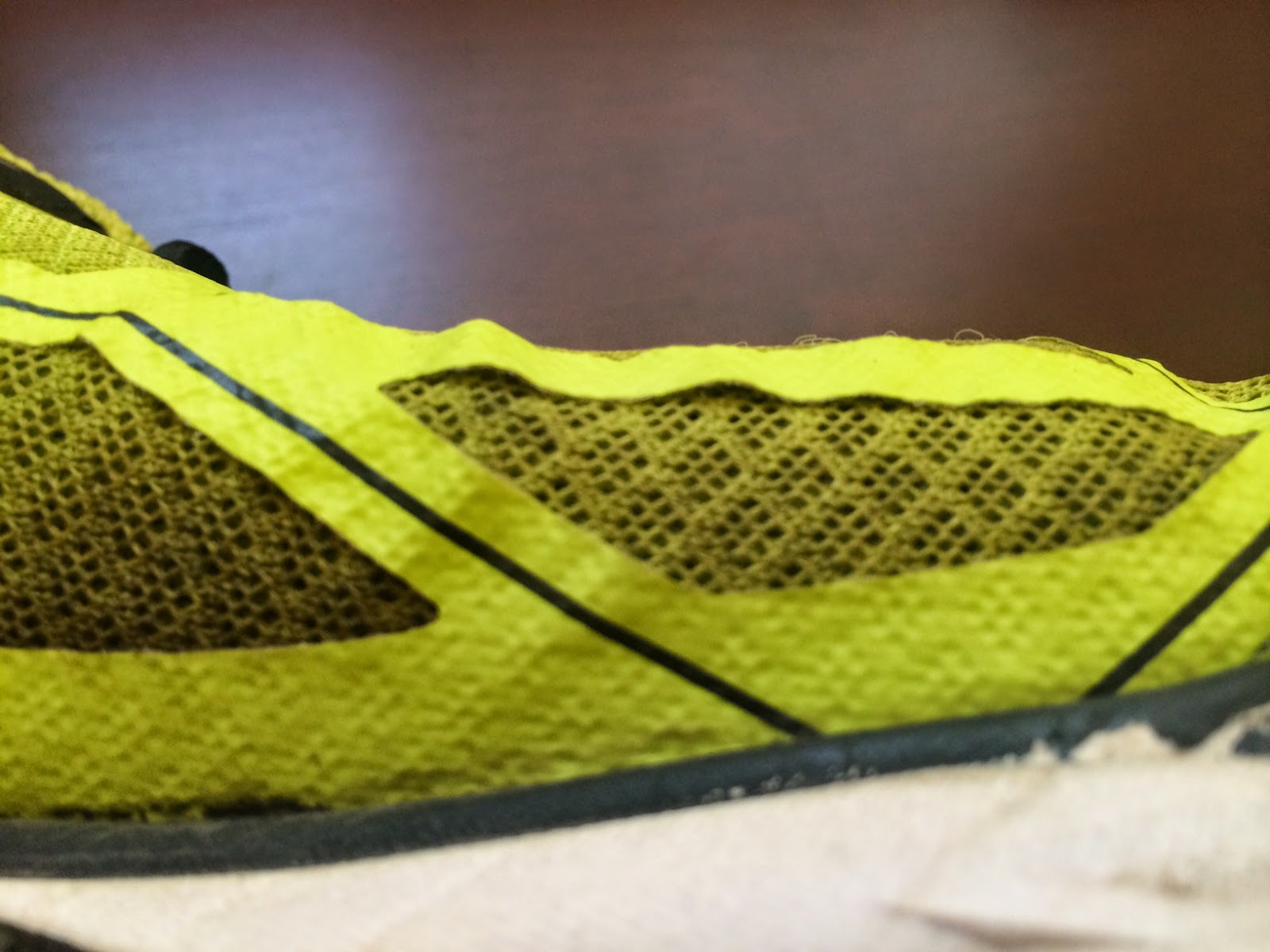
Overall, the uppers have held up very well, although frame is starting to delaminate from the mesh in some places. 


Turning the shoe over, the rubber overlays are holding up great.  However, the exposed foam near the front of the shoe has worn down significantly, and is starting to wear down elsewhere as well.


My biggest concern, however, is with the midsole.  On the medial (inner) side of the insole, the foam is showing numerous compression lines.  


However, on the lateral side it looks as good as new.


As a result, the shoes are starting to lean inward, and I can feel it when I run.  I worry that pretty soon, they'll be putting me at risk for injury.
 

But to be fair, the midsoles may last longer for lighter runners (I am 190 lbs), or those with different running form.

While I love the Cliftons, at $130 I'm not likely to pick up another pair for use as a frequent trainer.  However, I can't wait for them to go on sale. 
 

Tuesday, October 7, 2014

Shoe Review: New Balance Fresh Foam 980

image from runblogger.com
I'll admit that I (at times) ride the waves of marketing trends in running shoe technology.  I tend to think that any informed shoe choice takes into account the extremes; and the pendulum's well-documented swing from minimalism to maximalism has caught my attention.  That isn't to say I went out and bought a pair of Hokas (I'll leave that to Joel), but I did get swayed by the concept of a lower drop, maximally cushioned shoe.  Also, I've been meaning to give New Balance a try again; its been a while since I've tried their shoes and they have a very loyal group of followers.

I don't tend to write shoe reviews until I'm very sure of my opinion.  I've already logged 200 (or so) miles on the Fresh Foam 980 at the writing of this review.  Sadly, while I've learned a lot about the shoe over that period of time, one glaring fact stands in the way of me fully endorsing them:  the fit.  Fit is highly variable...  makes sense, FEET are highly variable.  For whatever reason, the designers at NB just didn't make a shoe with the 980 that fits my feet.  I discovered this the first time I took them Fresh Foam on a long run, and ended up with blisters.  I reaffirmed this the second time I did so with the same result (I very, very rarely get blisters otherwise).

While that pretty much assures I won't buy another pair, I do want to point out some of the positive things I like about this shoe; a shoe I still use for short runs on occasion:

1. It's got a 4mm drop with tons of underfoot protection.  Massive.
2. I've heard folks mention the cushioning is very stiff.  From my standpoint, this is a good thing.  My feet feel very protected, the shoes are plenty plush and they are responsive enough to handle any paced running.  Tough to have all of those things at once, in my mind.
3. The upper is light, but doesn't seem fragile.  In fact, the shoes look quite new even after 200 miles.

On the flip side:

1. The tongue is absurdly puffy and bothers the tops of my feet, moves around during the run.
2. The "fit issue" for me is related to the narrow toe-box.  Widen it up, NB!!

All-in-all, its a well-cushioned, light, low-drop shoe that, provided it fits, will get you through the miles at any pace you choose.


Thursday, September 4, 2014

Hoka One One Clifton review

There's been a lot of hype lately around the Hoka One One's new lighweight offering, the Clifton.  However, sometimes hype is just hype, so I ignored it for a while.  However, after reading positive reviews by two bloggers that I respect, by Sam Winebaum and Steve Speirs, I decided to pull the trigger.  I've now had them for about week, and have taken them on quick runs, slow jogs, and a long run of 17 miles.

For me, the most important attribute of a shoe is how a fits.  No shoe is going to fit every foot, but happily, the Hokas fit my feet well.  After swapping out the standard insolve for the thinner Ortholite insole (included in the box), they fit almost exactly the same as the Mizuno road shoes and North Face trail shoes that I ordinarily wear. 

The Cliftons are indeed soft, especially at the heel, and I worried a little bit about how well they would run.  It turned out that my worries were unnecessary.  The shoes turn over very quickly and with very little effort, and I consistently found myself to be running faster than I had planned.  And what's more, I was having fun doing it!

There are a few downsides that come with such a stripped down, ultra-cushioned shoe.  When I passed through a few wet spots in the sidewalk, my feet slid.  The Cliftons have very little traction.  And when I ran on the side of a cambered road, my foot sank much deeper into the cushion on the outside, making an otherwise very stable shoe become unstable.  I've also noticed more wear on the sole than I would have expected after 40 miles.  It may be nothing, but we'll see how long the Cliftons last.  (I've now posted an update looking at the Cliftons after 150 miles).

I'd originally envisioned these as a long run shoe, but I'm not going to have a hard time not reaching for them on days when I want to run fast, whatever the distance.


Monday, July 7, 2014

2014 Summer Running Gear

Here in the Nation's capital, it is hot!  In the month of July, we typically will see 14 days that reach 90 degrees or higher, and with the high humidity, it feels much hotter.  To keep running, you need the right clothes and the right gear.  Here is what has been working for me this summer:

The North Face Better Than Naked Hat.  Before this summer, I never liked running with hats.  They made my head hot, and the headbands frequently gave me headaches.  It turns out, I was just wearing the wrong hat.  This ultralight hat from The North Face keeps the sun out of my eyes, the sweat off of my face, and my head stays cool.

The North Face Better Than Naked Shirt.  Is it insane to pay $50 for a running shirt?  Not if it feels like it's made out of butterflies' wings.  The Better Than Naked Shirt is insanely light, it wicks sweat away quickly, and it never gets wet and heavy.  This shirt is simply light years beyond any other I've tried.  Durability remains a question mark, but so far, so good.

Salomon Trail Shorts.   Sorry, North Face, but Salomon still makes the best runnning shorts around.  Soft, comfortable waist bands, pockets that hold everything I need, legs that don't ride up or chafe.  Perfect.

Drymax Running Socks.  I used to wear Drymax Lite trail socks, but the regular running socks have a more open weave that breathes better.  It turns out, nothing is better than the original.

Amphipod Handheld.  Amphipod claims that their ergonomic shape allows the hand to relax, thus eliminating hand cramping and tension.  Personally, I've never heard a single runner every complain of hand cramping.  Regardless, this handheld is far more comfortable to carry than the typical round bottle, and the curved shape makes it easier to fill at water fountains.  There are all sorts of versions with neoprene insulating sleeves, iphone pockets, and the like, but I prefer the most stripped down version for its lower weight and lower price point.

What's been keeping you cool?


Thursday, July 3, 2014

Thoughts on a few Comix and the Kindle Panel Viewer

Most of the comics I’ve read over the last six months were on the Kindle reader.  The “Kindle Panel View” presents first the full page of the comic, and then you scroll through each of the individual panels on that page. It’s fascinating, and has both benefits and negatives. On one hand, it’s difficult to see the complete picture that all of the integrated panels construct – which can be a problem when reading Alan Moore comics, or comics where the layout contains unusual panels. On the other hand, zooming in on some of the smaller panels provides an intense focus on the brushwork details of the (for example, some of the amazing inking in the Swamp Thing's Floronic Man).  Overall, I still find myself wanting to read comix in their original format, but I imagine if I had a larger color screen I’d feel differently.


So what have I read? Let’s start off with the most recent: Saga of the Swamp Thing Book 1, which contains issues #20-27 of the series run, starting from when the imitable Alan Moore took over writing the story of this strange plant man. The first issue is a creepy but pretty straightforward closing of plot lines from the previous writer blatantly called “Loose Ends.” But with the next issue Moore started to put his stamp on the story, taking us into a trippy world where the Swamp Thing is more than just a cheesy monster but something of great power and beauty. Moore takes us on a journey, showing us how Swamp Thing realizes that the bio-restorative formula accident (a formula "that can make forests out of deserts") that that everyone thought  turned scientist Alec Holland into Swamp Thing in reality simply put Holland’s consciousness in some elemental plant-thing. (It’s much more interesting than I’m making it sound.) Despite the stories’ cosmic and epic nature, Moore's writing remains very human – giving us a depth of feeling and motivation behind most of the major characters in a way that most major label comics simply don’t have. Does it all work? No – cameos by the Justice League are strained, and the later issues where Swamp Thing confronts the bizarrely-clad demon Etrigan aren't nearly as moving as the issues without the rest of the DC Universe. Still, Moore’s immaculate pacing and creepy sensibility shine through, supported by Stephen Bisette and John Totleben’s detailed and creepy drawing. Their art - a strange mixture of awkwardness and twisted beauty – consists of lots of crosshatching flowing together in fascinating ways. It’s not at it’s best when depicting action sequences, or traditional “men-in-tights” superheros, but then that’s okay, since at it’s core this is a horror comic par excellence.

(As a side note, since I was reading this on the kindle it was black and white. I've since taken a look at the colored version on the iPad and it was a MUCH lesser experience IMO - the garish colors overwhelmed and took away from the mood and the beauty of the art. Be warned.)

Now the term "horror" is overused these days – it’s more of a genre description than a description of a feeling. Take Junji Ito’s Uzumaki, for example. Uzumaki  (“spiral” in Japanese) tells the tale of Kurôzu-cho, a Japanese town that is haunted by the pattern of the spiral and is touted as “a masterpiece of horror magna”. It’s a fantastic comic, one that’s genuinely creepy, disgusting, and macabre. But the book as a whole I can’t promote as true horror because the stories don’t combine to tell a complete tale. In reality, after the first few issues honest characters would have run screaming from the town, or crumbled into insanity under the weight of what they saw and their inability to escape it. But this is due partly to the episodic nature of monthly comix: Ito sets up his theme and explores it in inventive and genuinely creepy ways. (The man’s ability to generate genuinely horrific and disturbing images is uncanny.) But like weekly tv shows, the characters needed to be reset before each episode, or change so incrementally that they’re essentially the same. It's only as the series starts to reach its conclusion in the last few issues that it starts to really tell a cohesive tale. In short, despite many excellent moments, it doesn't have the depth of character to inspire the same levels of horror as Moore. But some of those images will just not leave my mind.

I should say that it's unfair to compare any other comics to Moore’s work. His ideas that span multiple issues or volumes seems to rise up out of him fully formed. For instance, check out Watchmen, and how single graphic frames in one issue will have powerful implications many issues down the road. Anotehr great example are the incredible multi-page spreads in Promethia where the art promotes the theme of the story while also moving forward the plot. In short, Moore thinks thematically while retaining a command of the details - a hard skill in any field, but one that is in short supply in comix.

Unless you also read Carla Speed McNeil's Finder, that is. She's the first comix artist since Moore that has impressed me with her thematic reach while being so impressive at a detailed level. (and I'm talking really detailed: check out the depth of thought revealed in the footnotes of her Finder Library volumes and you get a real sense for the amount of time and effort she's spent building up her world.) I have Volumes 1 & 2 and while I can’t say that I understand everything about it, she’s is simply a fantastic storyteller: both engaging & entertaining. What I love are the sheer profusion of bizarre details in her "aboriginal science fiction" – most of the stories take place in a far future where everyone lives in domed cities with fascinating technology, not all of which works (some details of maintenance have been lost to time). The main plotline is ostensibly about Jaegar, an aboriginal of some kind who can both track anyone (the Finder of the title) and serves as a “sin eater” (Wikipedia describes it as being a “ritual scapegoat” which I really like).  However, my favorite plot is Dream Sequence, where Magri White, a person who grows an extremely popular virtual reality in his head around which a successful corporation grows – but when White starts to lose his grip on reality, the people hooked on the world in his head start suffering strange and dramatic fates. The skill by which she weaves the effects of the big story together with the struggle in White’s life – and how she visually depicts White’s loosening grip on reality – is very complelling, to the point where I’ve revisited the story multiple times since it was first published in the late 2000s.

So other than the occasional Hellboy, that’s all of the comix I’ve been reading these days. What else should I be checking out?

Cross Posted on Thought Ambience

Friday, June 6, 2014

Book Review: Sergei Lukyanenko’s "Night Watch"

My attempts of describing of the plot of Sergei Lukyanenko’s Night Watch would take a carefully crafted world and crudely distill it down to an artless pulp, so you can read what it's about on Amazon. Lukyanenko doesn't  help matters by calling his agents of the Light and the Dark “the Others,” an unfortunate phrasing bringing to mind 50s B-movies and overwrought Nicole Kidman movies. But Lukyanenko infuses his struggle of good and evil with refreshingly liberal doses of Russian-tinged ambivalence and philosophy which, to this American reader, lifted the story above other countless fantasies superficially like it.

Anton Gorodetsky, the narrator for the large majority of the book, is a human with extraordinary magical powers. However, these powers don’t make him happy; rather, they're a burden that separates him from the rest of humanity and whose responsibilities weigh down his soul. This isn't helped by the fact that the collections of good and evil are divided into overtly complex and shadowy bureaucracies whose rules and structures provide an ironic blue collar contrast to the story. For instance, after a particularly rough experience, Anton’s team goes on holiday to the country and as a drunken bender, leading to this delicious observation:
“…now he understood what real Russian drunkenness was all about. … It’s all about waking up in the morning with everything around you looking grey. Grey sky, gray sun, grey city, gray people, gray thoughts. And the only way out is to have another drink. Then you feel better. Then the colors come back.” p.398
Anton drinks and desponds because this is heavy stuff. When things like the fate of the world and a keeping a millennium-long truce between good and evil hang on what you can accomplish, you might need a drink. And Lykyanenko does not take it easy on Anton – in the world of the Night Watch, the best you can hope is to not fuck up. To wit:
“Sveta, we’re not given the chance to choose absolute truth. Truth’s always two-faced. The only thing we have is the right to reject the lie that we find most repugnant. Do you know what I tell novices about the Twilight the first time? We enter it in order to acquire strength. And as the price for entering it we give up the part of the truth that we don’t want to accept.” p. 24
Another rehashing of Campbell’s Hero’s Journey, this is not. It's a dark book with a sensitively ambivalent heart. Anton wallows in for most of the book in Russian cynicism, but this only makes occasional flights into romanticism that much more powerful, partly because of the lack of irony. Lukyanenko’s writes as if the struggle is not only ongoing right now but also the most urgent thing in the world. All of this in an entertaining story that sprinkles its adventure and mysticism with a variety of interesting dilemmas. It kept me solid company for two solid weeks and I miss it's view of the world. I'll have to try one of its many sequels one of these days.

Cross posted on Thought Ambience.

Wednesday, January 29, 2014

Book Review: Chinghiz Aitmatiov’s "The Day Lasts More than a Thousand Years"

Chinghiz Aitmatiov’s The Day Lasts More than a Thousand Years is a timeless novel occurring at a very specific location and time – Kazakhstan in the late-to-mid period of the Soviet Union – and tells it in such a way that it speaks to everyone.

Aitmatov introduces us to Yedigei Burriani, a Kazakh worker on a Soviet railroad, who aims to bury his best friend in a historic Muslim graveyard. It’s hallowed ground because of Naiman-Ana, a long-suffering mother whose son was gruesomely transformed into a mankurt – an old Kazakh myth used here as a brilliant metaphor. In fact, as with any good Soviet novel, ambivalent metaphors abound: there’s even a science fictional subplot about our first contact with alien races that can be read as a prejudice of the unknown, as a critique of the Cold War, or even just as the impossibility of true communication between two sentient beings. And all of this occurs without feeling academic in the least – on the contrary, Aitmatov’s prose (translated by John French) is naturally beautiful, effortlessly flowing along from one story to another, always circling back to Burriani and his continual questioning about his purpose, and the conflict of the past with the modern. For example, the characters in the book honor the traditional Kazakh ways of living, (although Aitmatov doesn't whitewash out the harshness of this lifestyle) but also do not deny themselves the benefits of modern technology. On the contrary, Aitmatov seems genuinely excited about the possibilities of modernity – mainly the ability to quickly travel long distances and benefits of communications with other cultures that this engenders, but also smaller things. For instance, one great set piece involves Burriani’s famously powerful camel raging about in heat (powerfully symbolizing primal human emotions) but when it comes time to actually perform the burial, the hard work is done with a backhoe.

Overall, this may have been the most entertaining book I read in 2013. It came from an honest, true place and spoke to me on many levels. It was also a fascinating glimpse into a part of the world I know nothing about – just looking at some of the pictures of the Kazakh steppe quickly reveal how truly foreign this land is to me. Luckily we have fantastic books like The Day Lasts More than a Thousand Years to give us a sense of what it's like.

Cross Posted at Thought Ambience.

Monday, January 20, 2014

Review: Salomon S-Lab Advanced Skin M Belt Set

In 2013, Salomon's S-Lab debuted its first running belt, the Advanced Skin 2 Belt.  Although some reviewers noted it was a bit fiddly and that there were durability issues, most praised its light weight, breathable comfort, and ability to balance a load.  I was intrigued, but there was a deal breaker: the 2 Belt is designed to carry Salomon's 8-oz soft flasks.  In a race, those are great if you have a crew who will have bottles prepared for you before you arrive at the aid station.  But for the self-supported runner dependent on aid station crews to refill bottles?  Not so much.

Fast forward to 2014.  The S-Lab has produced its second belt, the Advanced Skin M Belt.  This belt is designed to hold Salomon's 16-oz soft flasks.  It has fewer pockets than the 2 Belt, but they are considerably larger, giving the M Belt 3 liters of storage capacity, where the 2 Belt had "only" a 2 liter capacity.  It also has various elastic straps for holding jackets, gloves, or other gear.  Thus, the M Belt holds much more than traditional packs, although still less than a backpack or vest. 

According to Salomon, the front piece is meant to hold energy and hydration, while the back element is meant to hold equipment and apparel.  Of course, a runner could wear either piece on the front or back.  I prefer to wear the front piece in front, but given that I don't travel with too much equipment, i put a 16-oz flask in the back.  A second 16-oz flask can be put in the front, depending on how much else I am carrying.  

the front

the back
(Speaking of flasks - Salomon appears to have updated the shape of the novel on its flask - the nozzles on the new flasks are wider at the top than the bottom.  Apparently these offer a higher flow rate; I've also noted that they are less apt to leak if the flask is accidentally squeezed).
2013 flask (left) and 2014 flask (right)

The M Belt itself is insanely light (together with an empty 16 oz flask, it weights just 4.2 oz), though of course if you load it fully, it can get heavy.  It is nice to have that weight around my hips, rather than on my shoulders.  By adjusting the top strap (which runs along my waist) somewhat tighter than the bottom strap (which runs along my hips), I've been able to dial in a fit that prevents bouncing even when the belt is full.  I've not had an issue with the straps slipping, which some runners reported with the 2 Belt.  


Lastly, the honeycomb mesh breathes wonderfully.  However, since this is the only layer between you and much of what you are carrying, things could get a bit damp inside.  


The M Belt is not yet available on Salomon's website, although a few select retailers such as Running Warehouse are stocking small numbers of it. I've not yet had a chance to race with it, but on a 20-mile run this weekend it performed admirably.   I'm looking forward to wearing it in my next race.

Tuesday, December 31, 2013

Book Review: Issac Asimov's "Foundation"

Foundation, the first novel in Issac Asimov’s famous Foundation series, speculates how to use a scientific sociology (here called “psychohistory”) to predict (and control) future events. As with most of Asimov’s writing, the prose is frequently leaden, but this is secondary to the ideas and plot. Indeed, the whole fun of this book is seeing how Hari Seldon’s plans to reduce a coming “galactic dark age” from 30 millenniums down to one plays out on an epic scale. And it is fun seeing Seldon's original hints and insinuations come to fruition, even if I didn't find it as engaging during my second reading. Still, I've read a fair amount of epic “space operas” since Foundation and very few of them stack up to the original. Recommended.

Cross posted on Thought Ambience

Monday, December 30, 2013

Book Review: Neil Gaiman's "The Graveyard Book"

A fun, fairy-tale like YA novel, Neil Gaiman’s The Graveyard Book is filled with magic, both literally and figuratively: many scenes are constructed such that you truly experience a sense of wonder. Magical books are a cliché, yes, but reading TGB reminded me of the books I loved as a kid, and how the world seemed new and filled with opportunity afterwards. What is magic if not that?

Not surprisingly given its title, the book starts with a murder. A boy’s parents are killed, and the only thing that saves the boy is being adopted by the ghosts and specters of the local graveyard. They raise him as one of their own, and his ongoing education is a fun take on the myths and history of these supernatural creatures.  (It's apparently loosely based on Kipling's The Jungle Book.) In particular, Silas, a vampire that takes the boy – now named Nobody Owens – under his care, is wonderfully depicted in how his fatherly nature and vampiric nature conflict and complement each other. My only criticism is that the story can occasionally feel a bit too pat, but that's probably the result of the genre more than anything, and certainly a minuscule price to pay for this little gem of a book.

Cross Posted on Thought Ambience

Friday, December 20, 2013

Book Review: Margaret Atwood's "MaddAddam"

Ever since I stumbled across an old paperback of Cat’s Eye, I've loved reading Margaret Atwood. Everything that I've read has been well constructed, thought-provoking, and highly entertaining. So I'm a bit surprised to have to report that MaddAddam - the final entry in her Oryx and Crake dystopia - is not the slam dunk I expected it to be.

Don't get me wrong: Parts have the propulsive narrative and interesting ideas that made the previous two books in this trilogy – Oryx and Crake (the best!) and The Year of the Flood - so compelling. But I’d be lying if I didn't say that I thought the characterization of the female characters – especially Toby, such a strong woman in TYotF – to be weak and inconsistent compared to their previous lives. Hell, Toby spends a good part of this book pining for or wallowing in jealousy for a man! In addition, parts of this book are - sadly - boring. This may be to the fact that she's revisiting scenes we've seen before in previous books, but also it's due to her framing devices, in which events are depicted at a distance. This is especially problematic with the climax of the novel, which is told as an afterthought and thus so removed from real-time action that it feels like a dream, and makes its repercussions (which were also blatantly foreshadowed beforehand) seem unreal.

This doesn't mean that the book isn't worth your time! On the contrary, any time spent in Atwood’s O&C world is worth it. It's a place where humanity has come to a horrible end through the efforts of the titular biologists who both design an ideal human being (the “Crakers”) and also unleash the apocalyptic virus via a designer vitality drug. There are so many fascinating and scarily prescient ideas here that exploring them is half the fun. MaddAddam in particular really gets rolling when she starts exploring Zeb’s story, the fascinating tale of this preacher's son who ends up intertwined in the lives of all of the main characters in what lead to the end of humanity.

Overall, though, what I found most interesting about MaddAddam was it's strange combination of hope and rebirth to what had been a relentlessly grim series. (The previous books read like The Road as written by Kurt Vonnegut.) The main arc of this third book is humanity’s efforts to rebuild and reestablish itself, perhaps most importantly with how to define its relationship with the Crakers and the other GMO beings (especially the pigoons: a pig with implanted human stem cells who escaped from their organ-harvesting fate and how are one of the most intelligent post-apocalyptic species).  And while I read the end of the book to be a delightfully snarky and ambivalent take on where all this might end up, overall MaddAddam is an interesting (if uneven) take on what happens the day after the world ends.

Saturday, November 23, 2013

Washington, DC Area Ultramarathon Reviews

This year, I have run three ultramarathons in the Washington, DC area: the North Face Endurance Challenge 50-Mile (June 1, 2013); the Athletic Equation 12-hour Adventure Trail Run (September 21, 2013); and the Stone Mill 50 Mile (November 16, 2013).

Rather than writing up a blow-by-blow of each race in its entirety, I thought I'd suggest some of the pros and cons of each race for those who are looking to run 50 miles (or so) in the DC area next year.

The North Face Endurance Challenge 50-Mile

Pros
  • Big Name.  The North Face Endurance Challenge is a big name race, as far as 50-milers go.  While local favorite Michael Wardian won the 2013 race, top competitors come from all over the country.  In addition to rubbing shoulders with the greats, you'll get treated to a lively sendoff and a serious finish line festival. 
  • Scenery.  Every other photograph of race is of the short section that requires rock hopping high above the Potomac gorge, but frankly, the entire course is beautiful, which runs along the wide Potomac and then in the hills of Great Falls national park, is amazing.
  • Swag.  The race costs $90 if you register on time, but it comes with some serious swag, including a high quality silkscreened technical shirt, socks, and a water bottle.  And, yes, a medal if you finish.
  • Spectator Friendly.  There aren't many ultras that pass four times by a big grassy picnic area where your family and friends can chill out and have a good time.  This is one of them.  
Cons
  • Course.  The first fifteen miles of this race is mostly flat, luring many runners into a marathon like pace.  They pay for it when they hit 20 miles of steep hills and gravelly fire roads and the aforementioned rock hopping.  The fact that three repetitive loops are required doesn't help.  Then, its 15 more miles to get back to the finish line.
  • Weather.  To make sure that the Endurance Challenge lives up to its name, schedulers put it in early June, when the weather in Washington, DC is anything but great for running.  The weather can be above 90 degrees and humid, as it was in 2013, or it can be very rainy, creating a mud-fest like in 2012.  Don't be hoping to set any PRs.

The Athletic Equation 12-hour Adventure Trail Run

Pros
  • Flexibility.  This could be a fifty mile race, but it doesn't have to be.  The goal is to run as many 6.5 mile loops as you can, in under 12 hours.  Some runners are here to rack up the miles, while others are happy to knock out a fast 20 mile and be home before noon.  So, decide what you want to do, and don't worry about anyone else.
  • Ideal Weather.  While late September can occasionally get a little warm, this generally is the perfect time of the year to be running in a T-shirt and shorts.  
  • Aid Stations.  The beginning/end of the 6.5 mile loop is a rollicking loop with music blaring and an ever changing array of food throughout the day.  (The pierogis, in particular, were awesome.)  If you have your own supplies, this means you can also hit your drop bag every 6.5 miles.  Midway through the course is a self-serve water stop, so you can run all day carrying just a single water bottle.  
  • Spectator Friendly.  Your friends and family will basically end up tailgating in the parking lot, but they do get to see you come by every 6.5 miles.
Cons
  • Value.  For $85, you get a pretty low-quality t-shirt.  You'll also get a pint beer glass if you finish.  I wouldn't call this race a bargain.
  • Repetitive.  There's a lot to like about a 6.5 mile loop - the aid station, seeing your family and friends - but by the end of the day, they get pretty boring.  A couple miles of long straight fire in the middle of the loop don't help.

The Stone Mill 50 Mile

Pros
  • Price.  Only $35 for a 50-miler?  That's unheard of.  I don't care that there's no swag.  At this price, sign me up.
  • Course.  The course is essentially a lollipop, with 20 total miles of out-and-back, and a large 30-mile loop in the middle.  While you're not exactly out in the wilds, there is plenty of scenic natural beauty, and something new to see around every bend.  And if you want to set a PR, this is the place to do it.  The course is 99% non-technical, and mostly soft underfoot (except for a mile or two of suburban sidewalk.)  Lots of soft rolling hills (and one brutal hill at the end!) to keep different muscle groups engaged, while giving others a rest. 
  • Aid Stations.  With 11 aid stations, you'll have a place to stop, on average, every 4.5 miles.  Sure, some are better stocked than others (and those that are well stocked are amazing with everything from hot soup to quesadillas to Knob Creek whisky), but regardless its nice to know there's always a friendly face and fresh water around the corner.  And the volunteers here were uniformly the best and most supportive of those at any of the three races.   
  • Camaraderie.  Maybe its the low key nature of the race, but I just met a lot more cool, friendly runners here than during any other race.  
Cons
  • The Basics.  Sure, the price is great.  But having only a single toilet for men at the start of the race meant a lot of runners were late to start.  Similarly, not having access to drop bags until mile 29 meant really loading up my pockets and hoping that I didn't need a change of socks.  This is a race that demands self-sufficiency.  
  • Late Year.  Running late in November makes for cool weather, which is great, but legs can be tired from other races.  It also makes for icy streams (and I lost count of the number stream crossings.)  It also means that many of the runners had to finish in the dark.     
Of course, there are other 50-mile races in the area that I haven't yet run, most notably the Bull Run Run 50-miler, in April, and the JFK 50-Mile in November, which is the granddaddy of them all.  I hope to report back on some of these next year!


Wednesday, October 30, 2013

Book Review: Kurt Vonnegut's "Bluebeard: The Autobiography of Rabo Karabekian (1916-1988)"

What an interesting book. Vonnegut's 1987 novel is about many things, but it's essentially the diary of Rabo Karabekian, a one-eyed failed Abstract Expressionist painter and how he learns to accept his weaknesses and creativity towards the end of his life. The story skips back and forth between the present narration and the past – his growing up with his Armenian immigrant parents, struggling through an art apprenticeship, his rise and fall in the serious art world. Vonnegut, as always, entertains while pulling off something deep – his glib prose belies the depth behind the thoughts and experience it details. What I found most interesting about the book was the conflict between its generally cynical tone and, in the end, its generally positive message. In this respect, it’s an old persons novel. I'm not really sure how to express it, so let me include some examples. The cynicism:
“A moderately gifted person who would have been a community treasure a thousand years ago has to give up, has to go into some other line of work, since modern communications put him or her into daily communication with nothing but world’s champions.
The entire planet can get along nicely now with maybe a dozen champion performers in each area of human giftedness. A moderately gifted person has to keep his or her gifts all bottled up until, in a manner of speaking, he or she gets drunk at a wedding and tap-dances on the coffee table like Fred Astaire or Ginger Rogers. We have a name or him or her. We call him or her an “exhibitionist.”
How do we reward such an exhibitionist? We say to him or her the next morning, “Wow! Were you ever drunk last night!”
And the humanity:
"I think--it is somehow very useful, and maybe even essential, for a fine artist to have to somehow make his peace on the canvas with all the things he cannot do. That is what attracts us to serious paintings, I think: that shortfall, which we might call "personality," or maybe even "pain." "
(More quotes here.) 
Other than Cat’s Cradle and Slaughterhouse-Five, Vonnegut’s other books haven’t always spoken to me. But this little gem of a novel blew me away.

Cross-posted on Thought Ambience

Thursday, October 24, 2013

Book Review: Richard Matheson's "I Am Legend"

I finally picked up Richard Matheson’s famous 1954 novel I Am Legend because I kept hearing how all three movie adaptations (The Last Man on Earth (1964), The Omega Man (1971), and I Am Legend (2007)) were good but not only missed the point of the book but fucked up the ending. Thousands of geeks can’t be wrong, so I set off to investigate.

What I found is a book that reads like a fast-paced thriller, but in which not much really happens. Robert Neville is the last survivor in a world filled with vampires. His house is a fortress in which he (impatiently) waits out his nights before staking as many vampires as possible during daylight. While this situation doesn't feel new (especially the detailed biological research on the cause of vampirism) that’s only because of how many books and movies have built upon Matheson’s creation. In other words, this is the original post-apocalyptic zombie text (the vampires might as well be zombies—to the point where Night of the Living Dead was inspired by it). Despite a (now) over familiar subject, IAL holds up well. It’s an emotionally honest work that depicts Neville’s struggles with apathy, anger, alcoholism and many other emotions resulting from his life of isolation and horror.

The ending is a twist that is so cynically powerful that I can see why movie execs are scared of it. (Spoilers!) By showing how Neville’s quest for “good” turns him into “evil” from other points of view, RM taps into an uncomfortable truth of human nature: that we’re all capable of the darkest deeds—while telling ourselves that we’re behaving altruistically.  And in a world ruled by vampires, Neville is guilty of the most heinous genocide. Now picture Will Smith or Charlton Heston committing these acts and becoming the poster boy of evil! The movies can’t (or don’t have the guts), and so entirely miss the point of Neville’s unwinnable scenario. After all, who among us could have handled Neville’s situation any differently? Few – if any – of us, I suspect, and so we’re forced to rethink all of Neville’s actions from the lens of the ending – not a comfortable experience.

I’m happy I read this book, although I have to admit to being bored at times; parts of Neville’s investigation take too long, and Neville and Ruth’s discussions are extremely dated.  But overall the book is a powerful touchstone for a lot of current popular culture – and it’s always good to go to the source rather than relying on the pale imitations. And you gotta love that ending!

Cross Posted on Thought Ambience.

Tuesday, September 3, 2013

Book Review: China Miéville's "Railsea"

Imagine… a world… where oceans…. don’t exist. In their place are deserts covered with massive amounts of train tracks twisting every which way – a maze of tracks spanning the majority of the globe. Welcome to Railsea, a fantastic yarn by everyone’s favorite New Weird author China Miéville.

At its core, Railsea depicts the quest of Abacat Naphi, the captain of the “mole train” Medes, who is in obsessive pursuit of an ivory-colored “moldywarpe” (think monstrously large mole).  But it’s also a coming-of-age story of Sham ap Soorap, who starts off as an inept doctor’s assistant but through a combination of luck and self-growth finds himself at the center of a race to the edges of the Railsea in pursuit of mythical lands – and treasure! It’s a compelling story that blatantly lifts ideas from other books – the captain’s quest is from Moby Dick, the abandoned alien tech (called alt-salvage) that litters the landscape is from the Strugatsky BrothersRoadside Picnic, etc.) – so creatively that the story never feels derivative or uninspired. In fact, with only one or two exceptions I didn't know what was going to happen next, a rare quality that makes all of his books extremely compelling.

I’m told that it’s a YA novel, a relatively meaningless distinction but does explain the (pre?) teen narrator and lack of serious swearing and sex. Regardless, all of the things I love about Miéville re here: unfettered imagination, linguistic wordplay, ample demonstration of his fierce intellect, unapologetic left-wing politics, and (of course) gigantic monsters. Relax and pour yourself a nice drink because this one’s a fun ride.

Related Posts: Book Review: "Roadside Picnic" by Arkady and Boris Strugatsky

Tuesday, June 25, 2013

And the winner is . . .

When you are running for half the day at an ultramarathon pace, the shoe with the best technical features may not be the best shoe for your foot.  Having learned this lesson the hard way, I began to shop for a cushioned trail shoe.

I narrowed down my choices to five shoes that have gotten excellent reviews.  Unfortunately, those reviews don't tell me how the shoes compare to each other in terms of cushioning, flexibility, and other factors.  So, I bought all five from Running Warehouse so I could try them all on . . .  and then send four back for a refund.

From top to bottom, Asics Gel-Fuji Trainer 2, Asics Gel-Scout, Brooks Cascadia 8, New Balance 1210 Leadville, Montrail FluidFeel
Since the purpose was to compare these shoes, I've ranked them against each other on the following factors:

Cushioning: The rankings simply indicate how much cushioning each shoe has, and not on which is best.  Different people like different amounts.  1 indicates the least, and 5 indicates the most.

Protection: After stepping on a variety of household objects, I have tried to anticipate how much protection each shoe will provide from rocks and roots on the rail.  Again, 1 is the least, and 5 is the most.  More protection means less road feel, so again, these are not rankings of which shoe is better.

Flexibility: Easily determined by twisting the shoe in various directions with my hands.  1 is the least flexible, 5 is the most.  (Do you sense a pattern?)

Width:  1 indicates the narrowest shoe, while 5 indicates the widest.  There was very little difference between the shoes ranked 3-5, so those rankings should be taken with a grain of salt.

Weight: From the lightest to the heaviest.

Note that I have not run in these shoes, and have no idea how grippy they are, how well they drain, etc.  The purpose of this test was simply to try them on and compare how they feel on my foot, since to me that is the most important factor over a long, slow race.

Asics Gel-Fuji Trainer 2
Cushioning: 1
Protection: 1
Flexibility: 4
Width: 3
Weight: 1
Notes:  This shoe feels "barely there" while still offering more protection underfoot than more minimalist shoes.  A tempting shoe, but they're not going to take me on much longer runs than the Inov-8 295s that I already wear.

Asics Gel-Scout
Cushioning: 3
Protection: 3
Flexibility: 2
Width: 5
Weight: 5
Notes: A exoskeletal heel counter, a visible gel pod in the sole, durable layers of mesh, a pocket for the laces on the tongue: this shoe is loaded down with visible technology.  Although it feels extremely stiff in my hand, it is somewhat more flexible when on my feet.  While it doesn't stand out to me, it is a comfortable, protective shoe that could appeal to many.

Brooks Cascadia 8
Cushioning: 4
Protection: 2
Flexibility: 3
Width: 4
Weight: 4
Notes:  Aaaaah!  Brooks has nailed it.  This shoe fits my foot beautifully.  The cushioning is softer than in any other shoe, perhaps a bit too soft for my tastes, but it will feel great over a long day on the trails. Now I see why these shoes are so popular among ultrarunners.  The one downside is that they are the most expensive of the shoes I'm trying on.

New Balance 1210 Leadville
Cushioning: 2
Protection: 5
Flexibility:  1
Width: 2
Weight: 2
Notes:  In my hand, the materials feels plasticky -- maybe that's why this shoe manages to be so light.  The upper feels fantastically comfortable on my foot.  As for the sole. . . while this shoe has a LOT of sole, it isn't very soft.  In fact, it feels stiff as a board under my foot.  I just can't imagine running in these.  But, stepping on household obstacles, I barely feel a thing.  A shoe only for those who want maximum protection.

Montrail FluidFeel
Cushioning: 5
Protection: 4
Flexibility: 5
Width: 1
Weight: 3
Notes: Out of the box, I didn't want to like this shoe -- it is so damn ugly.  But in my mind, this is exactly how a long distance running shoe should feel.  Lots of resilient, but not squishy, cushioning; outstanding protection, and somehow still an extremely flexible shoe.  Unfortunately, despite having a very wide, stable base, the fit is much, much too narrow for my foot.

Any of those shoes could be great for someone, but the winner (for me) is -- the Brooks Cascadia 8!

Thursday, April 4, 2013

Review: Maui Jim Hot Sands sunglasses

Bottom line: a lightweight, performance fit combined with Maui Jim's precision polarized optics makes this new model perfect for hours and hours of running. 

I am a big fan of Maui Jim sunglasses.  However, I think it is fair to say that their lineup is largely targeted toward fishing, golfing, and the beach.   For some time, I've been looking for a model that would be suitable for serious running, so I was pretty psyched to learn about a new style they introduced this year, the Hot Sands.

Now if you are looking for funky frames, strange lens shapes, or colorful coatings, you may need to look elsewhere.  With the Hot Sands you'll get a choice between four frame/lens combinations, any of which you could easily wear with a suit if you were so inclined:

Hot Sands: four choices
  • Gloss Black with Neutral Gray lenses 
  • Blue with Neutral Gray lenses 
  • Rootbeer with HCL Bronze lenses
  • Translucent Matte Gray with Maui HT lenses

Personally, I think that the Blue frames with Neutral Gray lenses look particularly fantastic.  However, this isn't a choice to be made based on which pair are most styling; with Maui Jim each color of lens is designed for a different purpose.  I have a pair of Kahunas and I can testify that neutral gray lenses are made for preserving rich color in direct, bright sunlight.  However, since I tend to start my runs early in the morning, and often will continue running until the late morning or afternoon, I opted for a pair with the HCL bronze lenses, which have a warm brown tint, and are the most suitable for a wide variety of lighting conditions.  (The Maui HT are strictly for early morning and late afternoon).  

Out of the box, I could tell immediately that these sunglasses are solid.  They hug my face well, are very comfortable, and they stay put.  They are super light: the frames are made from Grilamid, a flexible polymer that is lighter in weight than the material used in traditional frames.  The temples have rubber inserts and the nose pads are adjustable, all of which makes for a secure fit.

But the most important thing is the lenses.  While Maui Jim makes a lot of their lenses out of glass, these are made of lightweight polycarbonate.  Frankly, I thought the optical quality was just as fantastic.  In the early morning, the tint is light enough that I can make out the details of the trail clearly, but they still provide major relief from the mid-day sun.  The lenses are also polarized, and when I wore them while jogging across a snow colored field, I found they were terrific at cutting glare.  Other features to take note of is that they treated to repel water, and to resist smudges and scratches.  I'd still keep them in the case when not on my face, though.

Here's what you get
Speaking of the case:  the Hot Sands come with both a hardcase and a soft bag that doubles as a cloth for cleaning the lenses.  The bag reflects Maui Jim's Hawaiian heritage, and while its bright tropical pattern reduces the chances that you'll misplace it, I do wish it was more discrete.


But that's a very small quibble that can easily be forgiven, especially given that I recently took them out on a five hour run and they were so light, so comfortable, that I barely knew they were there.  I'll certainly be wearing them at the North Face Endurance Challenge 50-miler in June.


The Hot Sands aren't marketed exclusively toward runners, but they provide everything that this runner is looking for.  But quality doesn't come cheap: Maui Jim prices them at $189, which is just a little bit less than some of the most popular high-end running sunglasses out there.  In my opinion, though, they are worth every penny.


yours truly