Showing posts with label Trail Running. Show all posts
Showing posts with label Trail Running. Show all posts
Sunday, September 28, 2014
.jpeg)
.jpeg)
.jpeg)
.jpeg)
.jpeg)
.jpeg)
.jpeg)
.jpeg)

.jpeg)
Friday, September 5, 2014
Long Island Running: the Greenbelt Trail
 |
| The only good picture I could find of the Trail Map |
I stay at the Hyatt next to Hidden Pond Park in Hauppauge, NY. By looking carefully, I was able to find the entrance to the trail on the north side of Long Island Motor Parkway, which was a break in a chain-link fence overgrown with vines. Once inside, I worked my way up and down some steep hills, moving somewhat slowly due to the loose gravel on the trails. This first portion of the trail system has a series of interconnected trails - some are single track, some are wider and designed for mountain bikes. Continuing north, you'll drop down into Hidden Pond Park itself, where the path flattens out once you start to see the swimming pool and baseball fields. There are a number of trails running around this complex, but if you keep winding north, you'll find yourself in a narrow trail winding in a small right-of-way between neighborhoods and golf courses. Despite this, all of my runs on the northbound portion of the Greenbelt Trail were quiet and isolated - I think I've seen one other person in all of the times I've run there.
I should mention the strange blaze system in the HPP. White blazes mark the main trail, but when coming to a fork or change in direction, there are two white blazes - the second one to ostensibly indicate the change in direction, but it's somewhat confusing. These are interspersed with blazes of different colors, but I haven't determined the reasoning behind these markings, nor have I seen a trail map anywhere. Regardless, once you hit the golf course, the trail is unmistakable.
After crossing Townline Road, the trail is more rural, following a stream and a few tranquil bodies of water. As such, there are a number of helpful wooden bridges over the more marshy portions, all of which were constructed by the local Boy Scouts. (Thanks!) The trail twists and turns, and contains a large amount of roots, so it's hard to keep up a fast pace here, but you'll want to take it slow anyways to enjoy the silence and to catch all of the rabbits bouncing out of your path.
The most challenging part of the runs i've done here was traversing route 347. It's essentially a highway, with no crosswalk or lights anywhere nearby, so you just have to wait for a break in the traffic and sprint across. It's worth it though because the next section of the path takes you through some confier forests with all of the quiet running that involves - the pine needles just swallow up the sound of footfalls. The trail continues from here all of the way to the North Shore, but i've only gone as far as the shopping center in Smithtown. Click here to see my longest northbound run on Strava here.
The section southbound from Hauppauge is located directly across the road from the northbound trail on Long Island Motor Parkway. Here, the trail follows the power lines for a bit, weaves through some significant rolling hills with evergreen trees before dropping down to Old Nichols Road. On the other side of the road, the trail is pleasantly flat, meandering around some horse farms before meeting up with the power lines again. At this point, I lost the trail - the map indicates that the trail continues down to the Long Island Expressway, (somehow) crossing it en route to the southern edge of the island. Here's what this portion of the run looks like. I'm planning on giving this another go during one of my next trips because there's a nice looking Strava segment south of the interstate that I'd like to tackle.
In summary, there are some trails in the meat of Long Island, you just have to know where to look! If anyone reading this has any other good suggestions for running in the Hauppauge area, please drop me a line in the comments.
 |
| Bridge over a marshy area |
 |
| McKinley Pond. Usually see a Heron here! |
Saturday, November 30, 2013
Vicki's Death March - 2013
On Friday, I joined up with a group of other VHTRC members to run the 10th annual Vicki's Death March, a scenic run through some of the best trails in Shenandoah National Park.
My thermometer read 20 degrees at the start, so there wasn't much lollygagging. Quatro Hubbard offered a few comments and made sure everyone had turn sheets, and then we were off. The group quickly broke into smaller groups according to ability and desire.
.JPG)
.JPG)
.JPG) After a long push up White Oak Canyon with its spectacular waterfalls, my group found itself pondering whether conditions would allow us to keep going up to Hawksbill Peak, the highest point in the Shenandoahs, or jump on the Appalachian Trail and cut things short. We saw more footprints going up than coming down, and decided to give it a go. I'm glad we did.
After a long push up White Oak Canyon with its spectacular waterfalls, my group found itself pondering whether conditions would allow us to keep going up to Hawksbill Peak, the highest point in the Shenandoahs, or jump on the Appalachian Trail and cut things short. We saw more footprints going up than coming down, and decided to give it a go. I'm glad we did.
.JPG) While the running should have been mostly downhill from there, we were also a section that got very little sun, and the ice made the footing treacherous. Happily, I only slipped and fell once. On some of the steeper downhill slopes, my hip was giving me trouble, a holdover injury from the Stone Mill 50 two weeks before.
While the running should have been mostly downhill from there, we were also a section that got very little sun, and the ice made the footing treacherous. Happily, I only slipped and fell once. On some of the steeper downhill slopes, my hip was giving me trouble, a holdover injury from the Stone Mill 50 two weeks before.
.JPG) At about mile 13 I left my group go on ahead while I stopped to take a few pictures. Despite my best efforts, I never caught them again. Without their guidance, I found myself frequently referring to the turnsheet, determined to cover the entire course.
At about mile 13 I left my group go on ahead while I stopped to take a few pictures. Despite my best efforts, I never caught them again. Without their guidance, I found myself frequently referring to the turnsheet, determined to cover the entire course.
.JPG)
.JPG) When I got back to the car, I discovered that my group had stopped in at Skyland Resort (mile 15.6) for pie and coffee, and then taken a shortcut back. Indeed, many of the more experienced runners took advantage of the day to run longer or shorter routes, according to their own pleasure. In fact, as I discovered while looking at my GPS track later, I managed to put a couple of extra miles on, most of it around the Stony Man cliffs and again while looking for an unmarked path to the Corbin cutoff.
When I got back to the car, I discovered that my group had stopped in at Skyland Resort (mile 15.6) for pie and coffee, and then taken a shortcut back. Indeed, many of the more experienced runners took advantage of the day to run longer or shorter routes, according to their own pleasure. In fact, as I discovered while looking at my GPS track later, I managed to put a couple of extra miles on, most of it around the Stony Man cliffs and again while looking for an unmarked path to the Corbin cutoff.

All in all a fantastic day. Thanks to Quatro and the other VHTRC members who organize this outstanding run.
My thermometer read 20 degrees at the start, so there wasn't much lollygagging. Quatro Hubbard offered a few comments and made sure everyone had turn sheets, and then we were off. The group quickly broke into smaller groups according to ability and desire.
.JPG)
.JPG)
.JPG)
.JPG)
.JPG)
.JPG)
.JPG)
All in all a fantastic day. Thanks to Quatro and the other VHTRC members who organize this outstanding run.
Monday, July 22, 2013
Grandeur Peak
While taking a trip to Utah last week, I decided to hustle my way up to the top of Grandeur Peak, using the steeper trail from the west. Eric has generously encouraged me to call this activity "running."
.jpeg)
 I decided to hit the trail before dawn, figuring that nobody would be around to see this slow East Coaster make his way up the mountain. But as I got out of my car and got my bearings, a couple of trucks pulled up, and some guys jumped out, started their watches, and began running toward the trail. There was no chance I'd be keeping up.
I decided to hit the trail before dawn, figuring that nobody would be around to see this slow East Coaster make his way up the mountain. But as I got out of my car and got my bearings, a couple of trucks pulled up, and some guys jumped out, started their watches, and began running toward the trail. There was no chance I'd be keeping up.
I nearly did turn my activity into a real run, though, when I missed the Grandeur Peak trailhead and just kept jogging along the Bonneville Shoreline Trail. After about five minutes, it hit me that this wasn't what a 29% grade was supposed to feel like. I turned around and found my way to the single track trail that went straight up that mountain.
.jpeg)
.jpeg)
.jpeg)
.jpeg)
A half mile from the the top, I spotted the two dudes who had beat me out the gate, now tearing down the trail toward me. I stepped off the trail to let them pass, and they stepped off at the same time to let me pass. "I don't like to let strangers see my fall on face," one of them offered. "That's why I came alone," I countered.
.jpeg) Still closer to the top, I heard a click-click behind me, and turned around to see a guy speeding to toward me using mountaineering poles. How long he had been following me, I had no idea. I was grateful to take yet another break and let him pass. I would see him again on his way down.
Still closer to the top, I heard a click-click behind me, and turned around to see a guy speeding to toward me using mountaineering poles. How long he had been following me, I had no idea. I was grateful to take yet another break and let him pass. I would see him again on his way down.
.jpeg) Other than some amazing views, the top of the peak was pretty unremarkable. I lingered for a while, looking at Salt Lake City from a kilometer up, then turned back down the trail.
Other than some amazing views, the top of the peak was pretty unremarkable. I lingered for a while, looking at Salt Lake City from a kilometer up, then turned back down the trail.


Coming back down didn't take much energy. It was all about coordination, trying not to fall while letting gravity do the rest. I did fall once (not on my face, luckily) but that's because I was trying to take a drink of water while running, instead flailing my arms around to the sides like a maniac. Of course, I also took more pictures on the way down.
.jpeg)
Other than the steep grade, the trail was not overly technical. It had its rocky moments, and was grown over with scrub oak in a few place. My Brooks Cascadias did a great job of biting into the loose trail and keeping me from sliding down the trail. Impressively, I didn't see even the tiniest piece of trash on this popular trail. We in the East could take a lesson from Utah. (Now, if only Utahns would learn the meaning of switchbacks...)

.jpeg)
.jpeg)
.jpeg)
I nearly did turn my activity into a real run, though, when I missed the Grandeur Peak trailhead and just kept jogging along the Bonneville Shoreline Trail. After about five minutes, it hit me that this wasn't what a 29% grade was supposed to feel like. I turned around and found my way to the single track trail that went straight up that mountain.
.jpeg)
Within 1/2 mile I was huffing and puffing pretty hard. I looked at my watch and found I was only 800 feet. 2,500 more feet to go. I decided if I was going to make it to the top, I'd better stop and take more pictures along the way. Luckily, 2013 has been an unusually wet year for Utah, and the trailside was covered in green and flowers, so I had plenty of opportunity.
.jpeg)
.jpeg)
.jpeg)
A half mile from the the top, I spotted the two dudes who had beat me out the gate, now tearing down the trail toward me. I stepped off the trail to let them pass, and they stepped off at the same time to let me pass. "I don't like to let strangers see my fall on face," one of them offered. "That's why I came alone," I countered.
.jpeg)
.jpeg)

.jpeg)

Coming back down didn't take much energy. It was all about coordination, trying not to fall while letting gravity do the rest. I did fall once (not on my face, luckily) but that's because I was trying to take a drink of water while running, instead flailing my arms around to the sides like a maniac. Of course, I also took more pictures on the way down.
.jpeg)
Other than the steep grade, the trail was not overly technical. It had its rocky moments, and was grown over with scrub oak in a few place. My Brooks Cascadias did a great job of biting into the loose trail and keeping me from sliding down the trail. Impressively, I didn't see even the tiniest piece of trash on this popular trail. We in the East could take a lesson from Utah. (Now, if only Utahns would learn the meaning of switchbacks...)
.jpeg)
Tuesday, March 5, 2013
Review: Roclite 295 (old), Roclite 295 (new), Trailroc 255
Up until now, I have been a dedicated wearer of the Inov-8 Roclite 295 for my trail runs. This year, Inov-8 released a significantly updated version of the Roclite 295. In this review I share my first impressions of the new Roclite 295, comparing it against both the old Roclite 295 and the very popular Trailroc 255.
The bottom line: Inov-8 appears to nail the update to the Roclite 295. The Trailroc 255 provides a more protective option.
Typically when a shoe company updates one of its models, it does so with a lot of fanfare and discussion new technologies. Not so Inov-8 with its quiet release of the new Roclite 295 a few weeks ago. The specs on Inov-8s website indicate that the new Roclite has a 6mm heel drop instead of 9mm (in Inov-8 parlance, it is now a 2-arrow shoe instead of a 3-arrow shoe), but otherwise, they don't offer much in terms of describing the differences. I love the old version, so it was time to get hands on and see how things had changed.
So let's talk about the changes. First, this is almost certainly a lighter weight shoe. (Running Warehouse agrees: they weighed the old version at 10.5 oz, and the new version at 9.7 oz). So much for the claim that the shoe's model number represents the weight of the shoe in grams!
How was this achieved? First off, a much lighter mesh in the upper. The laces are also lighter, there is less of a protective rand around the front and the sides of the shoe, and the overlay material is thinner. My only concern is that some of this material feels a little plasticky and less likely to wear as well. We shall see.
Now lets move to the sole of the shoe. Not only does the new 295 have a lower heel, the overall height of the shoe has also dropped. I again turn to Running Warehouse for measurements. The old 295 measured 21 mm at the heel and 12 at the forefront, including the 6 mm lug height. The new 295 comes in at 17 mm and 10 mm. And yet, the shoe does not feel any less protective. I am not sure how this was achieved, but it may be through the use of injected EVA, which is becoming standard on new Inov-8 model. (The old 295 used standard EVA).

The fit of the Roclite 295 hasn't changed. A quick walkaround test suggests that the my toes will be happier now that the rand does not extend over the top of the toebox. I can no longer feel the cleats, and I suspect that these shoes will run better on pavement, when necessary. A slight concern is that the new 295s feel, less "sticky" -- perhaps the brightly colored rubber isn't quite the same, or maybe they just need to be roughed up a bit.
While the new Roclite 295 hasn't gotten a lot of attention, Inov-8's new Trailroc lineup has gotten a ton. There's plenty of information about them floating around the web, but I wanted to compare them side-by-side with the Roclite.
The biggest immediate difference is in the fit. Trailrocs are built on Inov-8s "Natural" last (formerly known as the "Anatomic" last). By contrast, Roclites are built on the "Endurance" last (formerly known as the "Comfort" last). Both provide plenty of room for the toes to spread, but from the heel to the midfoot, the Trailrocs fit like a tight glove, anchoring the foot firmly in place.
Underfoot, the Trailroc 255 has shallower lugs, but a thicker sole than even the old Roclite 295s. (Running Warehouse measures them at 22 mm at the heel and 16 mm at the forefoot). And indeed, they feel "high" to me. That height will provide protection, but at the expense of groundfeel. The sole is also narrower at the heel, so they felt a bit less stable.
The Roclite 295 is a much more flexible shoe than the Trailroc 255. In my hand, I can twist it every which way, which I can't do with the Trailroc 255. This is, part, because the Trailroc 255 includes a five-fingered shank (or rockplate) that extends all the way up to the front of the shoe. By contrast, the shank in the less protective Roclite 295 only extends midway up the sole.
As for the uppers, The Trailroc 255 seems to have a more substantial mesh. The rand is softer and more flexible, and the heel is also more flexible than in the Roclite 295. Frankly, the materials in the Trailroc 255 feel like they are higher quality, and I imagine they will get more miles before they wear out.
Inov-8's marketing suggests that the Trailroc line is designed for "dry and loose" trails, which makes sense given the amount of protection they offer. However, other reviews suggest the soles are good on a variety of surfaces. I expect that the deeper lugs of the Roclite will be better able to deal with mud, however.
I'll be running in the Roclite 295 because I appreciate its light weight, its relaxed fit, its ground feel and its suitability for a variety of trail conditions. Here in the southeast, I don't need the protection that the Trailroc 255 offers, and would feel constrained by its more substantial upper, especially when the weather warms up.
The bottom line: Inov-8 appears to nail the update to the Roclite 295. The Trailroc 255 provides a more protective option.
 |
| Roclite 295 (old version), Roclite 295 (new version), Trailroc 255 |
Typically when a shoe company updates one of its models, it does so with a lot of fanfare and discussion new technologies. Not so Inov-8 with its quiet release of the new Roclite 295 a few weeks ago. The specs on Inov-8s website indicate that the new Roclite has a 6mm heel drop instead of 9mm (in Inov-8 parlance, it is now a 2-arrow shoe instead of a 3-arrow shoe), but otherwise, they don't offer much in terms of describing the differences. I love the old version, so it was time to get hands on and see how things had changed.
So let's talk about the changes. First, this is almost certainly a lighter weight shoe. (Running Warehouse agrees: they weighed the old version at 10.5 oz, and the new version at 9.7 oz). So much for the claim that the shoe's model number represents the weight of the shoe in grams!
How was this achieved? First off, a much lighter mesh in the upper. The laces are also lighter, there is less of a protective rand around the front and the sides of the shoe, and the overlay material is thinner. My only concern is that some of this material feels a little plasticky and less likely to wear as well. We shall see.
Now lets move to the sole of the shoe. Not only does the new 295 have a lower heel, the overall height of the shoe has also dropped. I again turn to Running Warehouse for measurements. The old 295 measured 21 mm at the heel and 12 at the forefront, including the 6 mm lug height. The new 295 comes in at 17 mm and 10 mm. And yet, the shoe does not feel any less protective. I am not sure how this was achieved, but it may be through the use of injected EVA, which is becoming standard on new Inov-8 model. (The old 295 used standard EVA).

The fit of the Roclite 295 hasn't changed. A quick walkaround test suggests that the my toes will be happier now that the rand does not extend over the top of the toebox. I can no longer feel the cleats, and I suspect that these shoes will run better on pavement, when necessary. A slight concern is that the new 295s feel, less "sticky" -- perhaps the brightly colored rubber isn't quite the same, or maybe they just need to be roughed up a bit.
While the new Roclite 295 hasn't gotten a lot of attention, Inov-8's new Trailroc lineup has gotten a ton. There's plenty of information about them floating around the web, but I wanted to compare them side-by-side with the Roclite.
The biggest immediate difference is in the fit. Trailrocs are built on Inov-8s "Natural" last (formerly known as the "Anatomic" last). By contrast, Roclites are built on the "Endurance" last (formerly known as the "Comfort" last). Both provide plenty of room for the toes to spread, but from the heel to the midfoot, the Trailrocs fit like a tight glove, anchoring the foot firmly in place.
Underfoot, the Trailroc 255 has shallower lugs, but a thicker sole than even the old Roclite 295s. (Running Warehouse measures them at 22 mm at the heel and 16 mm at the forefoot). And indeed, they feel "high" to me. That height will provide protection, but at the expense of groundfeel. The sole is also narrower at the heel, so they felt a bit less stable.
 |
| Roclite 295 heel vs. Trailroc 255 heel |
The Roclite 295 is a much more flexible shoe than the Trailroc 255. In my hand, I can twist it every which way, which I can't do with the Trailroc 255. This is, part, because the Trailroc 255 includes a five-fingered shank (or rockplate) that extends all the way up to the front of the shoe. By contrast, the shank in the less protective Roclite 295 only extends midway up the sole.
 |
| Dig that flexibility! |
As for the uppers, The Trailroc 255 seems to have a more substantial mesh. The rand is softer and more flexible, and the heel is also more flexible than in the Roclite 295. Frankly, the materials in the Trailroc 255 feel like they are higher quality, and I imagine they will get more miles before they wear out.
Inov-8's marketing suggests that the Trailroc line is designed for "dry and loose" trails, which makes sense given the amount of protection they offer. However, other reviews suggest the soles are good on a variety of surfaces. I expect that the deeper lugs of the Roclite will be better able to deal with mud, however.
I'll be running in the Roclite 295 because I appreciate its light weight, its relaxed fit, its ground feel and its suitability for a variety of trail conditions. Here in the southeast, I don't need the protection that the Trailroc 255 offers, and would feel constrained by its more substantial upper, especially when the weather warms up.
 |
| Parting glance |
Wednesday, November 28, 2012
The Evolution of My Running
It’s been almost a month and a half since the New RiverTrail 50k. It’s been a month and a half
since I have been training for anything, running hard or seriously or even
blogging about running. And yet, I’ve
never been more “in love” with running.
The NRT 50k was an evolution of sorts in my still-young
running life. Sure, I started to come
apart towards the end, probably didn’t fuel well enough and am still somewhat
hobbled by the physical after-effects of training for and racing in that
race. Regardless, it can be counted as
no less than the best running experience I have had to date.
Strangely, since running that race, the feeling I crave from
running, the feeling I most want to feel when out for a run is the feeling I had
at my lowest point in that race (mile 27).
I was down and out, just passing by the mileage marker of my longest
ever run, under-fueled, limping and completely isolated (after having spent
most of the first 3 hours of the race with some great folks). I was struggling.
I just kept reminding myself, “I choose to do this, and I do
it because I love it; This is what I’m here for, this is what I trained for.”
And the training paid off.
And that’s what makes me want to be back in that place, testing my
training, testing my mind, my ability to persevere; testing my love of running.
The year is winding down now and there are no significant
goals left to accomplish. My mileage for
the year will be well above the goal I had set at the beginning of the
year. I’ve run all the races I had
planned to run. I had some great
experiences and some bad experiences.
Most importantly, learned a heck of a lot about how and why I run and
running in general.
Heading into 2013, I’m already focusing on a 24 week
training cycle, starting the very first day of the year (just before that,
actually), targeting at getting me ready for the North Face Endurance Challenge50 mile race in Washington, DC. I’ll be
lucky enough to run that race with Joel again, and we’ll go through our (vastly
different) training cycles together as well.
Going into 2012, the focus was on running longer. The hope was that I could run longer and lose
only minimal speed. What I learned,
quite unfortunately, is that I lose quite a bit of speed the longer I run, much
more than I had hoped. Training for a 50
mile race is going to have to be about abandoning any idea of speed altogether.
I never fully grasped the idea of “running by feel” before
the NRT 50k. Call it a result of being
under or over-trained for races, but the way I felt in races leading up to that
one could only be characterized using negative terms. If I were running by feel, I wouldn’t be
running at all, it would seem. But in
stretching my runs out longer than I ever thought possible, I’ve started to
realize just how amazing the human body is.
I haven’t quite determined if “running by feel” is fully coupling the
body and mind, or fully de-coupling the body and mind. The reality is that there are most likely
times when coupling works best, and other times when de-coupling works best… and it’s that adaptability that really
defines running by feel.
Running by feeling really blows open the doors on my
enjoyment of running, however.
Forgetting about the watch, about whether I’m running too fast or too
slow for goal pace and focusing about my perceived effort has allowed me to
become much more in tune with my body and with my surroundings. This is especially true on trails, when not
being in touch with my body and surroundings will result in a face plant. Some days, after I get back from the run,
upload it and see what transpired, I’m quite amazed at how much faster or
slower the run is than what I perceived.
But I think the value of understanding how much effort you are exerting
relative to how much energy you have in reserve, how to properly push the pace
when you are hurting, and back off it (even when you are not hurting) to ensure
you’re going to be able to finish and run the race you want to run is fully
supported by training in this manner, and so it will be my motif during this
training cycle.
I’m also working on my Metabolic Efficiency. There was an article in October’s
Ultrarunning magazine (one of the best running magazines out there, in my opinion, for runners of any distance) about how to train your body to become more efficient at
burning fat as fuel. This makes perfect
sense to me. If my stomach is off and I can’t
take in calories for a period of time, I want to be able to keep pushing on
without taking a huge physical or mental toll.
I want my body to operate as efficiently as possible in all conditions,
and I realize just feeling comfortable on my training runs isn’t going to get
me there. So, for the past 2 weeks and
for the next four, I’ll be eating a (vegetarian, as always) diet high in
protein (with a bit more fat than usual) and lower in carbs than I normally
eat. I won’t fuel specifically for any
training run, nor will I fuel during any training run. Too, I’ll be running SLOWLY (so as to keep my
heart-rate in the right zone for optimal ME training) and for a duration
between 1 hr 30 min and 2 hrs for as many runs as I can. This should lead right into the beginning the
training cycle for the 50 miler, so the timing is perfect. Generally, I would just build a
cardiovascular base before a training cycle anyway, so it’s not terribly
different from what I would normally plan, with the exception of the
nutritional aspect.
Training for and racing in the 50-miler is going to take up
the first half of next year. I plan to
throw in a 50k race in that time (hopefully the TARC Spring Classic) and
possibly a fast half marathon with Todd (the Quincy Half again?). Beyond that, I don’t yet know. Maybe I’ll try for another marathon at the
end of next year, see if I really can run as fast as I want to run for that
distance? We’ll see. I think a lot depends on how the 50 miler
goes... I could end up signing up for a 100 miler, or I could end up hanging up
the shoes altogether.
But for now, I’m loving running more than I ever have, and I
feel so lucky to have had such a great and relatively injury free year of
consistent running (haven’t had a single week without logging at least one run
all year). I’m really looking forward to
tackling the 50 mile distance and figuring out where I want to go with my
running from there. Onward!!
Tuesday, October 9, 2012
5 days 'til 50k
Here I sit in the familiar state of madness induced by
tapering from a strenuous training cycle.
Am I ready? Am I over-trained,
injured even? Should I be running
more/less right now? Am I eating right?
I’m not a life-long runner.
I never ran in high school, never considered running for fun until I was
well into my 20s. Even then, I never
took running seriously until I started racing.
I’ve never run a 50k (~31 miles) before, much less trained for racing
that distance.
 |
| A tough day |
I spent the better part of the month after KBVCM getting ART therapy, rehabbing my legs and rethinking my approach to running. The bitter unhappiness I felt after having
put in such an arduous training cycle left me at an impasse with running: Why work SO hard for such little result? The moral of many “survivor” stories is “for
the personal satisfaction of it”, but that isn’t the moral of this particular
story.
When I started running again, I did it without obsessing
about splits, without worrying whether I was hitting a predetermined weekly
mileage volume. I forgot about pace and
ran for the sake of running. I ran more on trails, in the woods, away from cars and traffic, and I was surprised to
find, away from other runners. I would
often stop in the middle of a run to look at a group of turkeys off the trail, a
deer grazing nearby, or just simply to take in my surroundings. My mental state was becoming fueled by my
running adventures. I’d never in my life
run slower, but I’d never in my life run for longer; not necessarily in terms
of mileage, but in terms of time on feet.
 |
| The Ridge between Bonfcliff and Bond |
I learned a lot about fueling myself on long runs, hydrating
and taking in calories. I learned about
how far past the “I don’t want to” feeling I can push myself, and how that “I don’t
want to” feeling comes at different times and in different ways on every
run. I learned about how my mental state
is equally if not more important than my physical state for my ability to
continue to push on in those “no man’s land” miles beyond where I ever thought I
was capable of going.
My lungs and legs felt very strong, but I felt very
slow. When September rolled around,
realizing the race was a little over a month away, I started to panic. The New River Trail 50k is run on trails, but
hardly the trails I'm used to. The
race is entirely flat, on primarily crushed gravel trails. Running 25 miles through the White Mountains
involves quite a bit of hiking and technical sure-footing. Running
up and down hills on trails engages different muscle groups at different times,
evening out the fatigue and allowing for a bit of recovery as you shift pitches.
.JPG) |
| Charles River Path |
All of these long runs were slow. Much slower than the long runs I did in the
lead up to KBVCM. I felt slower, I FEEL
slower and certainly, with the lack of speed work, I am. How much slower is very hard to say. A few weeks ago, Todd and I did one of the
ever-popular Let’s Run, Have Fun and Be Fit series runs along the Charles
River. Last year, we did the same run,
the “Halfway to Mardi Gras” race. Last
year this was a 4.2 mile race. We had
no reason to suspect it would be different this year (and I certainly didn’t
read the fine print) and so when it ended after 5k, I had a little bit left in
the tank. Even so, I ran my second
fastest 5k time. 5k speed has very
little to do with 50k speed, but at least my lack of speed work isn’t going to
be a primary concern going into this weekend’s race.
 |
| Joel running in Rock Creek Park |
Side note: After having gone through a spell where I
felt like I wasn’t recovering well, where I was consistently over-tired and
cranky, not able to put my heart into my runs, I did some research. Many signs and the fact that I am a
vegetarian made me a prime candidate for iron deficiency. I started supplementing with Floradix. I put 1 tablespoon in a glass of orange juice
every morning before I drink coffee (caffeine lessens the body’s ability to
absorb iron) or eat anything. I’ve tried
a variety of supplements in my life time to help a variety of symptoms; none
have had such a clear effect as supplementing iron has. It didn’t happen overnight. It took about 4 weeks for me to notice
anything, but it was clear to me then that iron is a very important part of my
diet when I am training so hard.
Related Posts:
Tuesday, August 28, 2012
How to Make Your Runs Longer?
It's not what you think. Boing Boing recently posted about the science behind why we perceive time to pass quickly or slowly. William Reville, emeritus professor of biochemistry at University College Cork, writes in The Irish Times that:
It makes sense, but I'm not sure how this theory accommodates the flip side of this: if you're running in a place that offers you no new information - like a treadmill - the time can drag interminably. In my book, there's nothing worse that running on a treadmill without an interesting podcast or movie, because time just... seems... to... stop...
What's your experience?
“Time” is related to how much information you are taking in – information stretches time. A child’s day from 9am to 3.30pm is like a 20-hour day for an adult. Children experience many new things every day and time passes slowly, but as people get older they have fewer new experiences and time is less stretched by information. So, you can “lengthen” your life by minimising routine and making sure your life is full of new active experiences – travel to new places, take on new interests, and spend more time living in the present.The implication here is that running on new routes or using different techniques will make the runs feel longer. Personally, I also enjoy the meditatively qualities that come with running along a route multiple times, forgetting myself and disappearing into a rhythm, but I think I understand what Reville is saying. It's why trail running is so exciting and addictive - you need to pay close attention to what you are doing or you'll fall, and that's why trail runs always seem to take so much longer than running on pavement.
It makes sense, but I'm not sure how this theory accommodates the flip side of this: if you're running in a place that offers you no new information - like a treadmill - the time can drag interminably. In my book, there's nothing worse that running on a treadmill without an interesting podcast or movie, because time just... seems... to... stop...
What's your experience?
Wednesday, July 18, 2012
A Day in the White Mountains (NH)
This past Saturday, a couple local running friends (David and Erich) invited me to tag along on their trip up to the White Mountains to run the Pemi Loop. While I've been hiking in the Whites plenty of times, I've never done a run there, so I was cautious in my planning, figuring to run about the first 10 miles of the 32 mile loop, and then double back for a 20 mile day.
I got up at 3:30 AM on Saturday morning and by 3:45 I was on the road. The drive in was quite easy, as there is no traffic at that time of day. I was still in a partial sleep-coma as well, which may have been why I barely remember the drive. By 6:15, I was at the trailhead. We had hoped to start at that time, but it took the three of us about bit of time to get our things together and it was closer to 7 when we headed out.
The forecast for the day had the temperature heading into the low 90s with high humidity. I drank about 2 liters of water before the start of the run, on the drive up, and had 3 liters of water in my camelbak. We started off slowly on a flat trail that was formerly a railroad bed, frequently stepping over the old railroad ties still left on what has become the Lincoln Woods Trail.
After about 4 miles or so and a turnoff onto the Bondcliff Trail, we started a very gradual climb, completely runnable. I believe it was around mile 6 that we started any significant climbing and by mile 7 there was much more power hiking than running. The climb was pretty steep at times, with your typical New England trail features of rocks and roots along the way. Anytime the trail leveled, we'd run a stretch and then hunker down into climbing mode when it became unrunnable again. At one point in the trail, the trees break and you can see the Bondcliff Ridge above:

A little after mile 8 we broke into the alpine zone, above the treeline:
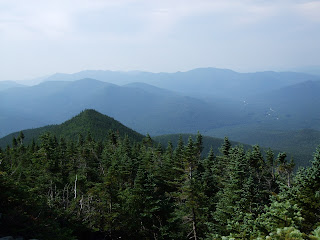
The temperature was quite nice in the morning hours up on the ridge, and despite the loose rock, the terrain was reasonably runnable. I found it hard to run however because I was simply gawking at the sheer beauty of the ridge and surrounding areas. The Bondcliff peak has a very dramatic drop off that you run along for a bit:

After summiting Bondcliff, the ridge loses a bit of elevation before beginning the climb to Bond. Here is a view from Bondcliff of the summit of Bond with David and Erich running the ridge:

The climb to bond starts on the exposed ridgeline and the heads into some distressed alpine pines for a step ascent. This was all hiking for me at this point. David and Erich were kind enough to wait for me on the summit of Bond, but soon-after descended into the trees to continue their run (they had 8 more 4000'+ peaks to get over and 22 more miles of running left):

Now on my own, I took stock of how I felt, which was pretty good, took in a bunch of calories (gu and clif bars) and checked in on my water situation. At the halfway point, I had already downed 2 liters of water and the temperatures were quickly on the rise. I knew that it wouldn't be long before I got to a stream that we followed for a long ways on the journey in, but i didn't have a water filter or any tablets.
To look at the elevation chart, you'd assume i could have just charged down the mountain at this point:

Not so, however. As you can see from these pictures, I had to pick my way through some pretty technical terrain. As this was the first time I've navigated through these types of trails in running shoes, I didn't try to push it:
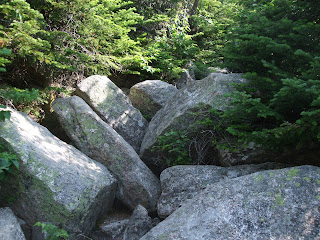

As I was saying before, the ridgeline is really amazing though, and I was fun to be running slowly over the ridge to have more time to take in the views:


Alas, with the temperature on the rise and the water situation getting more important, I finally began my descent below the treeline. Miles 11 and 12 were still pretty steep and technical, so I ran when I could, but i didn't take any chances. I was starting to get really hot at this point, and I was out of water, so by mile 13, I was really glad when I got back to the stream. I didn't care much about not having a filter or tablets at that point and drank beyond my heart's content. To cool off, I gave my head a nice dunk as well:

Much like on the way in, I ran the remaining miles, gaining steam as the terrain flattened out. This was beyond a doubt the slowest 'run' I had ever done with all the climbing and tricky terrain on the descent and i wanted to see if I still had anything left. Back down off the peaks, it was downright hot, and I was pretty keen to get to my car which had 2 full bottles of ice water. I finished my run, downed one of the bottles then soaked in the nice, cold stream for about 20 minutes. I then changed my shoes (my feet took a beating) and set out for a short hike, hoping to meet David and Erich on the tail end of their run. Turns out they ran out of water and were dealing with dehydration issues, so I headed back to the stream, had a nice chat with another runner of the Pemi Loop that day and awaited their arrival.
All in all, I learned a lot from running with David and Erich and a lot from my experience in the Whites on this day. It offered some incredibly beautiful views and an overall great, even if a little hot towards the end, experience. Can't wait to get back up there!
I got up at 3:30 AM on Saturday morning and by 3:45 I was on the road. The drive in was quite easy, as there is no traffic at that time of day. I was still in a partial sleep-coma as well, which may have been why I barely remember the drive. By 6:15, I was at the trailhead. We had hoped to start at that time, but it took the three of us about bit of time to get our things together and it was closer to 7 when we headed out.
The forecast for the day had the temperature heading into the low 90s with high humidity. I drank about 2 liters of water before the start of the run, on the drive up, and had 3 liters of water in my camelbak. We started off slowly on a flat trail that was formerly a railroad bed, frequently stepping over the old railroad ties still left on what has become the Lincoln Woods Trail.
After about 4 miles or so and a turnoff onto the Bondcliff Trail, we started a very gradual climb, completely runnable. I believe it was around mile 6 that we started any significant climbing and by mile 7 there was much more power hiking than running. The climb was pretty steep at times, with your typical New England trail features of rocks and roots along the way. Anytime the trail leveled, we'd run a stretch and then hunker down into climbing mode when it became unrunnable again. At one point in the trail, the trees break and you can see the Bondcliff Ridge above:

A little after mile 8 we broke into the alpine zone, above the treeline:

The temperature was quite nice in the morning hours up on the ridge, and despite the loose rock, the terrain was reasonably runnable. I found it hard to run however because I was simply gawking at the sheer beauty of the ridge and surrounding areas. The Bondcliff peak has a very dramatic drop off that you run along for a bit:

After summiting Bondcliff, the ridge loses a bit of elevation before beginning the climb to Bond. Here is a view from Bondcliff of the summit of Bond with David and Erich running the ridge:

The climb to bond starts on the exposed ridgeline and the heads into some distressed alpine pines for a step ascent. This was all hiking for me at this point. David and Erich were kind enough to wait for me on the summit of Bond, but soon-after descended into the trees to continue their run (they had 8 more 4000'+ peaks to get over and 22 more miles of running left):

Now on my own, I took stock of how I felt, which was pretty good, took in a bunch of calories (gu and clif bars) and checked in on my water situation. At the halfway point, I had already downed 2 liters of water and the temperatures were quickly on the rise. I knew that it wouldn't be long before I got to a stream that we followed for a long ways on the journey in, but i didn't have a water filter or any tablets.
To look at the elevation chart, you'd assume i could have just charged down the mountain at this point:

Not so, however. As you can see from these pictures, I had to pick my way through some pretty technical terrain. As this was the first time I've navigated through these types of trails in running shoes, I didn't try to push it:


As I was saying before, the ridgeline is really amazing though, and I was fun to be running slowly over the ridge to have more time to take in the views:


Alas, with the temperature on the rise and the water situation getting more important, I finally began my descent below the treeline. Miles 11 and 12 were still pretty steep and technical, so I ran when I could, but i didn't take any chances. I was starting to get really hot at this point, and I was out of water, so by mile 13, I was really glad when I got back to the stream. I didn't care much about not having a filter or tablets at that point and drank beyond my heart's content. To cool off, I gave my head a nice dunk as well:

Much like on the way in, I ran the remaining miles, gaining steam as the terrain flattened out. This was beyond a doubt the slowest 'run' I had ever done with all the climbing and tricky terrain on the descent and i wanted to see if I still had anything left. Back down off the peaks, it was downright hot, and I was pretty keen to get to my car which had 2 full bottles of ice water. I finished my run, downed one of the bottles then soaked in the nice, cold stream for about 20 minutes. I then changed my shoes (my feet took a beating) and set out for a short hike, hoping to meet David and Erich on the tail end of their run. Turns out they ran out of water and were dealing with dehydration issues, so I headed back to the stream, had a nice chat with another runner of the Pemi Loop that day and awaited their arrival.
All in all, I learned a lot from running with David and Erich and a lot from my experience in the Whites on this day. It offered some incredibly beautiful views and an overall great, even if a little hot towards the end, experience. Can't wait to get back up there!
Subscribe to:
Posts (Atom)